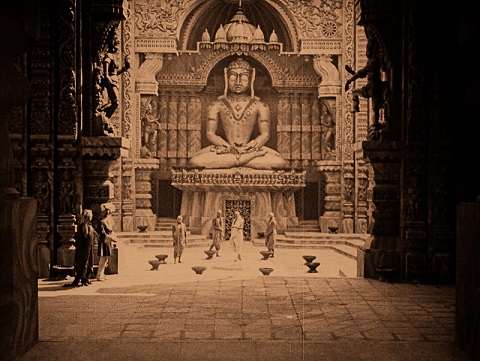
They say among the mystics of India that the highest level of yogi can control their bodies and environments so well that they will allow themselves to be buried in the ground to perfect their abilities in a perfect, trance-like state. Should they be awakened, they can do their master's bidding with their magical powers, and that is precisely what The Maharajah of Bengal (Conrad Veidt) has done after ordering the digging up of Ramigani (Bernhard Goetzke). Now back in the world of the living, the Maharajah has a task for him: track down a German architect, Herbert Rowland (Olaf Fonss), and bring him here...
Easy-peasy for a yogi, according to this anyway, all he needs to do is teleport to Germany and use his powers of persuasion. Rowland is, naturally, surprised, but he likes the idea of designing a tomb of a Princess in India so off he goes on a ship bound East, leaving his fiancee Irene Amundsen (Mia May) a note of explanation. A note the yogi supernaturally destroys, somewhat ominously, but she is a determined sort and suspects something is up, so gives chase using her deductive talents. You get the idea, The Indian Tomb may have been a two-part, four-hour-long movie from the silent era in Germany, but that did not mean they would hang about.
There was plenty of incident packed into that expansive running time, though quite a bit came across as a method of keeping the characters apart all the better to throw problems in their respective paths, meaning the structure of this - divided into subsections, or "Acts" - was closer to the serial craze that had taken off for filmmakers. This would continue into the nineteen-fifties at least, but the silent serials set out the template, and with its cliffhangers every twenty minutes or so, this was clearly what director Joe May and his writing team of Thea von Harbou and Fritz Lang had in mind, like a megaserial with lavish sets and breathless twists.
One such twist was that the Princess Saviti (Erna Morena) for whom the tomb is to be built is in fact still alive, and not only that but she's not in love with the Maharajah, she has given her heart to MacAllan (Paul Richter), a British colonial officer (a big no-no, there). The Maharajah was one of Veidt's lovelorn villains, and he pitched it perfectly with his accustomed soulful quality, piercing stares and otherworldly air, indeed had it not been for the equally strange Goetzke he would have walked away with the acting honours. Fonss and Mia May were surprisingly middle-aged for their heroic roles, May being the wife of the director and a decidedly matronly presence on the screen; some of her exotic costume choices were brave, shall we say.
Germany was of course competing on the world stage cinematically in the silent era, attempting to rediscover its lost pride after World War One and finding the movie industry an ideal method of showing its face to the planet after the national shame of the previous decade. The Weimar era films were not quite as sinister as some would have you believe, as many of the creatives behind them were fervently anti-Nazi and keen not to allow the toxic nationalism that led to their defeat at such great cost never gain another foothold. The Mays and Lang eventually had to leave Germany as their good intentions failed, but you will not see too much of that here, where the spectacle was the important aspect, and perhaps a romanticisation of the exotic could be regarded as a keenness to culturally appropriate (there was not one authentic South Asian in the cast). But you can put all that to one side when watching, should you choose to do so.
[Eureka release this on Blu-ray with the following features:
Both parts presented in 1080p HD, across two Blu-ray discs from 2K restorations undertaken by the Murnau foundation (FWMS) | Musical Score (2018) by Irena and Vojtech Havel | Optional English subtitles | Brand New video essay by David Cairns & Fiona Watson | PLUS: A collector’s booklet featuring new writing on the film by Philip Kemp.]
Born in Joseph Otto Mandel in Vienna, May was one of the founding figures of German cinema. May began directing in 1911 after working in operetta and set up his own production house, helping to establish Fritz Lang as a scriptwriter. May was a prolific director at the famous UFA studios, making films such as Asphalt and Homecoming, although he was more interested in crowd-pleasing pictures than the more groundbreaking work of Lang or F.W. Murnau.
Like Lang, May headed to Hollywood when Hitler began his rise to power. In 1937 he made the moody thriller Confession, starring Basil Rathbone, but subsequently found himself stuck making B-movies for Universal. The most notable were The Invisible Man Returns, House of the Seven Gables and the comedy Johnny Doesn't Live Here Anymore, starring a young Robert Mitchum. May retired from filmmaking in 1950 and died four years later in Los Angeles.