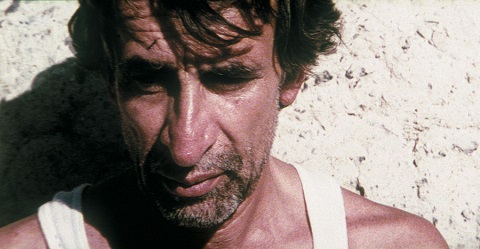
A painter (Alejandro Ferretis), who is lame in one leg, has had enough of his life and makes up his mind to travel a long way away from his big city home to the desert region of Hidalgo where he is to end his life for good. By and by he finds himself wondering where he is, and in the middle of nowhere he notices a small boy in the bushes who warns him to get down. The painter is confused until he hears the gunfire: the boy's father and his friends are shooting birds, and the child fetches one from the ground where it fell, though is not strong enough to break its neck and put it out of its misery. But the painter is more than capable...
With a beginning like that, it will come as no surprise to you to learn this sequence was cut by the BBFC in Britain, and while it did illustrate the protagonist's attitude to death, it was somewhat unnecessary to go into that degree of detail. But then there was the rest of the over two hours of film to consider, and the wider question, whether writer and director Carlos Reygadas was the new Andrei Tarkovsky or whether he was a pale imitation of the Russian master. The comparisons were mentioned in every review of Japon, though Reygadas quickly threw off the rather slavish imitations of his style to become his own thing after a few films of his own.
Post Tenebras Lux, for instance, is not really a Tarkovsky copy - but this item, made on a relative shoestring, was very close to that impersonation, with the long takes, the religious allusions, and somewhat impenetrable motivations of not only the characters but the director as well. Actually, this was a kind of romance, of a type not often seen in the movies, between the fiftysomething painter and the twenty years his elder little old lady, Ascen (Magdalena Flores), who he moves in with having reached his destination. This is a village where various rustic sorts are trying to oust Ascen from her humble abode, which she is seemingly going along with.
A widow living hand to mouth, she has her Catholic faith to keep her going, in contrast to the nameless painter who has lost all forward momentum in his life and seeks the sweet embrace of death - he has a pistol with which to do the deed, though he seems to be contemplating throwing himself off a nearby cliff as well. Actually the main attempt we see him stage ends embarrassingly, as it turns into a farce when he keeps falling over, and indeed injures his head in the process of taking a tumble. All that and winding up lying with his head practically stuck in the belly of a dead horse, as nature is as important to the tone as the religious aspect, though so much aiming for profundity risked Reygadas falling flat on his face into the bargain.
For some audiences, this was just vague enough to cast a spell over them, as they sat contemplating the infinite while it unfolded. For others, the dreaded word pretentious was never far away, and that extended to the filming techniques, shot on blurry 16mm (unless you could see a high definition print, in which case it was... a bit less blurry) but blown up to Cinemascope proportions for the epic scale mixed with the intimate for the relationship at its heart. There was one thing everyone who saw this agreed on, however: that final, minutes-long shot across a railway track was extraordinary, and if you made it that far was well worth waiting for even if it did not clear up the preceding couple of hours. Then again, there were certain to be viewers who bailed out well before that, and well before the surprising sex scene between the painter and Ascen, which was tenderly filmed but again, failed to explain itself. All this did announce an arthouse darling for the new century, give it that.