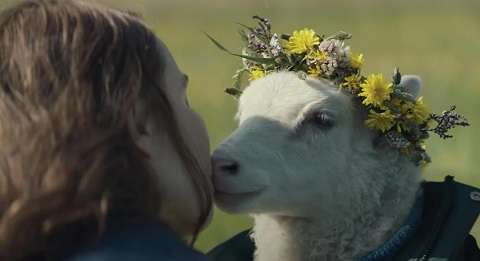
Maria (Noomi Rapace) and Ingvur (Hilmir Snaer Gudnason) run a sheep farm in the north of Iceland, and don't get many visitors, mostly being isolated from the outside world. But something approaches the place in the dead of winter when the blizzards are thick in the air, and spooks the local horses, then makes a move on the couple's sheep. They are largely oblivious to anything being amiss, but the animals are not, and sense there is something amiss in the wilderness, but their owners have enough on their plate to worry about. They have never been the same since losing their young daughter Ada, but what if they get a replacement?
And what if that replacement is not entirely human? This curio was the brainchild of screenwriters Valdimar Johansson (who also directed) and Sjon, one of Iceland's most acclaimed writers, but if anyone could have been said to take this concept and run with it, then it was star Noomi Rapace, who truly committed to what was at basics an absurd premise for a movie. It was she who made you understand that she is able to be surrogate mother to this creature because it fills a need in her life she can barely acknowledge consciously, and if anyone (or anything) was planning to take that away, she would fight tooth and nail against it to stop it.
Of course, she is not this hybrid's parent, though there is a time when we start wondering whether Ingvur could be the father and he has been indulging in bestial desires now that his marriage has seen him pushed away by Maria. Yet the film does not go the way you expect, assuming your mind was heading in that direction thanks to a thousand jokes about sheep farmers, and though there were points where Lamb became so bizarre the only reaction left available to you was to laugh rather than be nauseated (or maybe laugh because you were nauseated?), there was a strong undercurrent of sadness to what we were watching, born of human behaviour.
The creature's actual mother is, obviously, an actual sheep, and she has something to say about being locked out of her offspring's life, spending her time bleating at the front door of the couple's house in a bid to be reunited with the beast. There seemed to be a lesson for those who liked their lambs not gambolling in the fields but roasted on their plate with mint sauce, trying to make them feel guilty about the implications of their dinner and how it means children are effectively separated from their parents and slaughtered and devoured by humans, only in a ovine kind of way. But it went further than that, pondering the worth of the farms that do not always see humanity working in tandem with the natural world at all.
As long as the people are content, everything else can go to hell, is the attitude portrayed here, nowhere more than in the third man in this drama, Ingvur's brother Petur (Bjorn Hlnyur Haraldson) who arrives unannounced, apparently in exile, and moves in supposedly temporarily. The idea that we are all seeking happiness as long as it utterly fits our own narrow view of what our needs are was somewhere in the mix, and the creature is more of a pawn in that respect, but needs to be appreciated as an entity in its own right, not a child substitute, and not some aberration to be destroyed as Petur believes it should be. It should be highlighted Lamb took its time, so there was plenty of space allowed to chew over what was being relayed, so much so that it appeared to be so-called "slow cinema" in many stretches, and for anyone wanting a traditional horror movie, they were going to be disappointed. Though it had a horrific, desolate conclusion, it was more of a fantasy riffing on nature themes in reflective style - if that was your type of thing, you'd like it a lot. And Rapace was living every moment of those themes.
[Lamb will be released in cinemas in the UK and Ireland on 10 December 2021.]