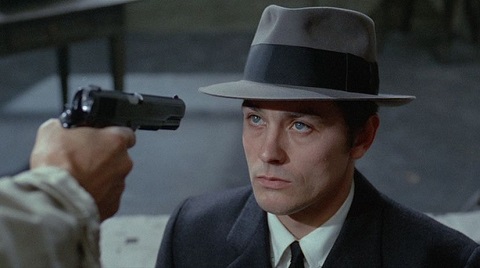
Jef Costello (Alain Delon) is a man of few words, all of them carefully chosen: judge him by his actions, for he is a professional hitman in Paris, and he has recently been paid millions of francs to perform a murder on a nightclub owner. Not having a car of his own, it is his wont to break into an unlocked vehicle and start it with one of about a hundred skeleton keys he has in his possession; this helps in keeping the cops off his back if they have trouble tracing him. However, this latest hit may prove tricky to place behind him, as those police suspect him of the crime and are proving mightily persistent in pursuing him...
Le Samourai is generally considered director and co-writer Jean-Pierre Melville's finest achievement in a career largely made up of ice cold crime thrillers and dramas, and certainly became one of the most influential cult movies of all time thanks to the amount of big directors who happened along in Melville's wake and were so impressed by this that they sought to garner a little cool by association by emulating it. It set its star on a path of crime flicks that were not exactly in the same vein, but did illustrate how audiences preferred to see him, and as one of France's biggest stars he was not going to let down his faithful public.
Of course, Delon became a controversial figure as the years went by and he seemed to prefer giving outspoken opinions in interviews, suggesting if you like a celebrity it is best not to ask for their views on politics. But as an icon of cool, he did sustain at least the surface appearance of that, and much of this was thanks to his role here, where he wore a trilby and raincoat as well as Humphrey Bogart, and delivered a performance of such minimalism that many were happy to read acres of meaning into his handsomely blank features. All he had to do was walk, straight backed, down a grey Parisian street and he seemed the epitome of that cool.
Melville assuredly knew how to use Delon to his best advantage, though one wondered whether the star quite understood what his appeal was in relation to this film, considering his later choices of roles, but despite his success, it seemed Le Samourai would be the one film of his that endured far into his future as not only did it anticipate the style for style's sake of cinema du look of the nineteen-eighties, but no matter the lack of actual action, many stars envied Delon's insouciance in this. Would it be churlish, then, to point out that while it was a joy to watch as a surface-based bauble of French movies, the plot was actually a bit silly? Some would tell you, if they admitted that, this was not the most plot-driven of productions anyway.
But we are asked to accept that the police find Costello so difficult to get a handle on that they bug his apartment, which he shares with a caged bullfinch that constantly cheeps and nobody else, so not much conversation, then, but also stage an elaborate electronic tailing exercise to ensure they can follow him anywhere he goes via officers wearing transmitters. If you're that convinced of his guilt, haul him in! As all this was happening, the gangsters who hired the antihero are getting upset that they have this unwanted attention and scheme to have Costello murdered - he's having none of that and commences running rings around them as well as the police. Maybe the film's fans were right: don't get caught up on the details, just enjoy the romance of the lone wolf, one man set against the whole world, and how his rebellious nature ensures he will become legendary, which in cinematic history was precisely what happened. Music by Francois de Roubaix.
[The Criterion Collection release this on Blu-ray with these features:
New high-definition digital restoration, with uncompressed monaural soundtrack on the Blu-ray
Interviews from 2005 with Rui Nogueira, editor of Melville on Melville, and Ginette Vincendeau, author of Jean-Pierre Melville: An American in Paris
Archival interviews with Melville and actors Alain Delon, François Périer, Nathalie Delon, and Cathy Rosier
Melville-Delon: D'honneur et de nuit (2011), a short documentary exploring the friendship between the director and the actor and their iconic collaboration on this film
Trailer
PLUS: An essay by film scholar David Thomson, an appreciation by filmmaker John Woo, and excerpts from Melville on Melville.]