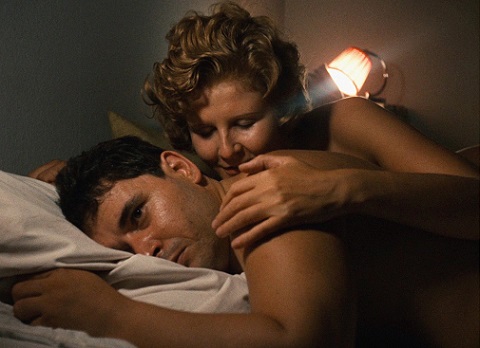
When Hans Epp (Hans Hirschmiller) left the Foreign Legion and returned home to Germany to visit his mother (Gusti Kreissl), he was not exactly greeted with open arms. In fact, his mother told him she hoped he had died in the service, and that the friend he had left with all that time ago had returned instead. After struggling with a job as a policeman, he winds up as a fruit vendor selling pears from a barrow he pushes around the housing complexes, assisted by his wife Irma (Irm Hermann) who has given him a young daughter, but as far as love goes, she can be as cruel as his mother. Such is Hans's lot...
The Merchant of the Four Seasons, or Handler der vier Jahreszeiten if you spoke German, was the first hit for cult director and key exponent of the German New Wave of the nineteen-seventies Rainer Werner Fassbinder. He had been plugging away at the filmmaking lark since the late sixties with not much success outside of specialist areas, but in his endeavours to emulate his hero Douglas Sirk, a Golden Age of Hollywood filmmaker though originally from Germany like Fassbinder, he suddenly found an audience who in the increasingly fraught social landscape of his country were more receptive to being, well, depressed, really.
This was a tale of depression as suffered by Hans, and the circumstances that led to it were picked apart in forensic detail by a plot that left no stone unturned in eking out every reason why he felt like utter shit all day, every day. Nobody appreciates him, everyone does him down, and when he does meet somebody who likes him they will always find a way of breaking his heart, or at least they would had that heart not been torn out and stomped into the dirt by life some time before - everything we see here is merely adding insult to injury. And what insults they are, as even when Hans retaliates he fails miserably in his quest to attain self-esteem.
It is appropriate, then, that shortly after resorting to beating up his wife, as much out of frustration as he is drunk, when he tries to reconcile with her it is so stressful he collapses with a cardiac arrest. It's the film's idea of a punchline to a succession of bleak jokes that were never funny in the first place, and there is more to come as his new invalidity means he cannot work on the barrow anymore since that requires heavy lifting of the fruit boxes. But it does mean he can devote himself to what has turned into his main interest: drinking alcohol, and that he throws himself into with unseemly enthusiasm, only pausing to note how unfulfilled his existence is now he has been forced to slow down. There is but one goal he has in mind.
Which is to drink himself to death - one can only wonder at the German audience of the seventies if this was their idea of a great night out, but it arguably provided the springboard for Fassbinder's successes for the next ten years, at which point he died of a drugs overdose, not yet forty. You imagine had this not been a hit, it would not have affected his output any (he was incredibly prolific) nor the subject matter of his filmography, and he would have patiently waited for his oeuvre to click, which it did, domestically and internationally. But even as it chimed with his countrymen and women back then, ironically appreciating the perfect dejection of this has become a niche interest decades after his death as cinema has lost interest in the mass appeal of these kinds of stories. Yet you can still discern that steeliness and embrace of the disaffected in films to this day, you simply have to seek them out more. Ahead of his time? Perhaps, but very much of his time too.