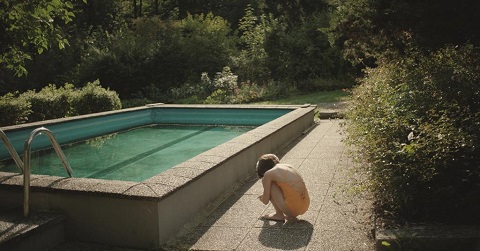
Elli caught a grasshopper today, she held it in her hand to feel it jumping around inside this makeshift prison she had made, then dropped it in the swimming pool to fend for itself. The swimming pool held a great attraction for Elli, and despite the warnings of her Papa (Dominik Warta) to be careful around the water, he was shocked to see yet again she had fallen in and was floating motionless on its surface. That was a nuisance for her Papa, but all he had to do was take her back to the house in the forest and reboot her using his phone, for this was the near future, and Elli was an android designed to replace his missing daughter...
One of the most controversial science fiction films of the twenty-first century, assuming you had heard of it, that is, The Trouble with Being Born was half Steven Spielberg's A.I., half Marjorie Prime, all unsettlingly emotionless look at how men and women would treat an android if they had one in their home. For the first half, the Papa - who is apparently called Georg - looks after a robot designed resemble a ten-year-old girl, which we discover has been bought and customised to resemble the daughter he lost a while back that, it is implied, led to the breakdown of his marriage and his own mental issues.
But maybe the mental issues started before that, as we also see that Georg, reasoning in a twisted way that he can do what he wants to what amounts to an object, is having sex with Elli, with her permission seeing as how she is in no position to deny him his perversions, and has been built to serve her master, if you will. You can see why that would be controversial, despite director Sandra Wollner doing her utmost to protect the young actress she cast as the robot, giving her a pseudonym, concealing her face under a latex mask so she would not be recognised, and ensuring any nudity involved was achieved through computer graphics.
Nevertheless, the blank nature of the tone may not endorse the treatment of the android, but it did not exactly condemn it either, and that was what was so disturbing. It was as if Wollner had taken the uncanny valley concept and run with it: should we be fearful for an object just because it looks like a little girl? Is it not merely a step up in technology from a talking, walking, battery operated doll? And it was not as if she was entirely convincing as a human being anyway. But that attitude tended to negate the fact that Elli had indeed been played by someone real, and Georg was not abusing the automaton because it was simply artificial, he was doing so because it resembled his daughter who he may well have murdered at some point in the previous years.
Was Wollner telling us that there will come a time when, should men control the conversation on lifelike robots, that they will have sex with them? If you looked at the "real dolls" phenomenon and wondered what they would be like if they could move, then that would appear to be the case, technological advances serving to fuel the perversions of the sort of men who are not able to have nornal relationships, and implying there will be no such thing the more the future becomes the present. And what of women? As the old lady Elli meets next relates, it would be companionship they wanted, someone to talk to rather than take advantage of - or was that just taking advantage in a different manner? It was accurate to observe the film was intended to be creepy, as well as thought provoking, but for too many the creepiness would be too much and shut down the critical faculties. With a keen eye for casually shocking detail, it was a very difficult film to give yourself over to. Music by Peter Kutin and David Schweighart.