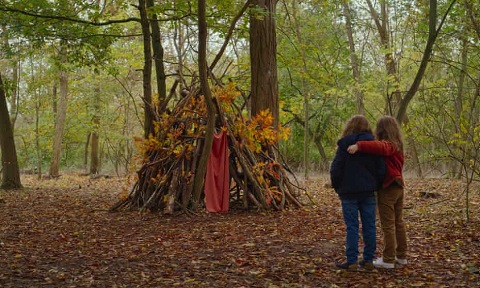
Nelly (Josephine Sanz) dutifully goes from room to room in this rest home for the elderly, saying goodbye to the old ladies who live there. Her grandmother used to live there too, but has passed away recently, and her mother (Nina Meurisse) has been called to collect her things from the room that is now vacated. This is obviously causing her some reflection and when Nelly requests to keep her gran's walking stick as a souvenir, she agrees but may have mixed feelings as the memories overwhelm her. What can the little girl do to comfort her mother in her state of grief? Does the pain go too deep into the past?
If you had come to writer and director Céline Sciamma from her previous film, the arthouse hit Portrait of a Lady on Fire, you may not have been prepared for what at just over seventy minutes could have been a sketch extended further than its comfortable duration instead of a substantial movie, and the question of whether you would want to spend time not with a work you could sit down with and really get to grips with over the course of over a couple of hours, but something more skimpy, was always going to be a pressing matter for a film too long to be a short, but not long enough to be a, er, long. But it held a curious power.
Citing Back to the Future as an influence, Sciamma set about putting a feminine spin on a similar subject, yet dispensed with the genre trappings of science fiction. When Nelly goes back in time to meet her mother at her own age of eight (played by the girl's twin sister Gabrielle Sanz) there's no real explanation for it other than her love for her parent and a desire to make her feel better, which is a motive a child would easily understand. But would meeting the eight-year-old version of her mother actually make her feel better, or would it merely make Nelly feel better - is this a selfish or selfless act she is undertaking? This is never quite resolved.
If anything, going back in time via a special location in the woods near the family home makes them both improve, but the mother, adult incarnation, is apparently suffering very badly from losing Nelly's gran and disappears from the story without explanation, leaving us to imagine all sorts of terrible things. The girl's father (Stephane Varupenne) does his best to accommodate his daughter and keep her spirits up, but the problems run deeper, for she may be far lonelier than she lets on, just as her mother was when she was a child and having to live with a parent who is suffering a debilitating bone disease she has inherited. Hence why there is looming a painful operation the mother must have to prevent the condition ruining her adulthood.
However, in the early, present day sequences, we can understand Nelly buoys her mother's mood even when she is at her lowest, rendering a sad film even sadder when the limits of how much that can help are reached. The time slip does help them both, and also assists Nelly negate the unthinkable, that her mother was as lonely as she is at her age: Sciamma makes a big deal of showing them playing, including roleplaying as adults in matters they might not quite grasp, or perhaps should not have to at their tender years. That was about it as far as plot went, but for what could have been slight, and maybe was a little, there were resonances that invited the audience to consider their relationship with their own parents, however that has gone since your childhood. It may make you more sympathetic towards them, equally it may disturb as there was something unsettling about the serene acceptance of this bizarre scenario that played out strangely blankly, turning the screen back on you. Music by Jean-Baptiste de Laubier.
[Céline Sciamma's Petite Maman In Cinemas 19 November 2021.]