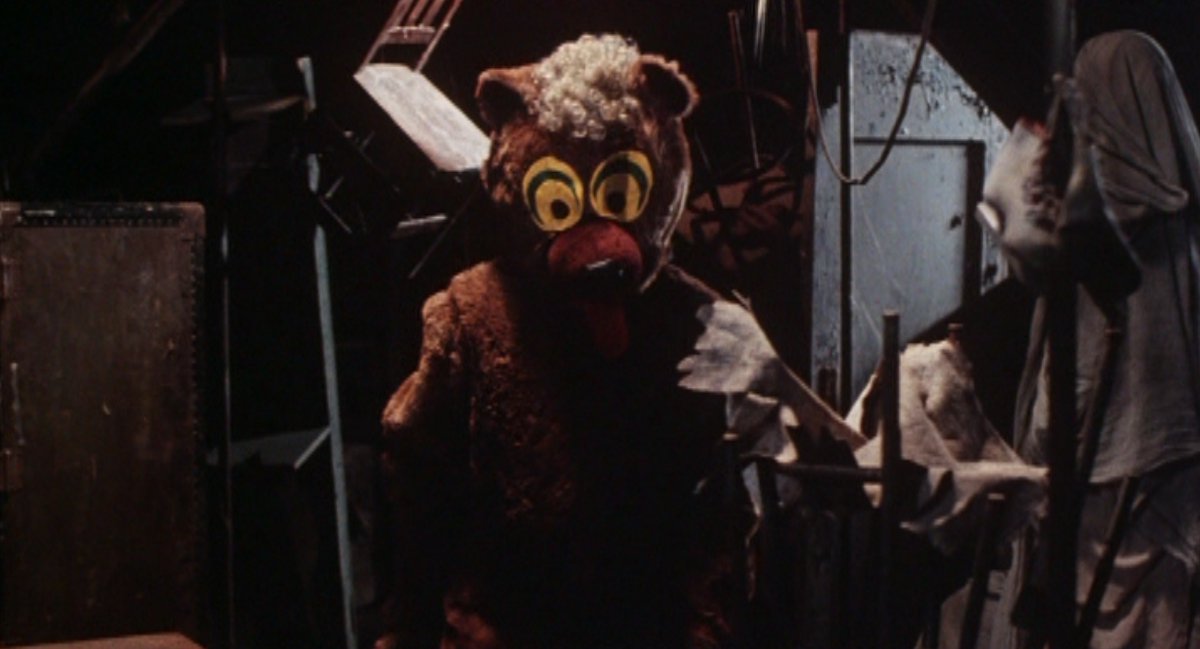
At Dewitt University a party to mark the start of the local sorority's annual scavenger hunt unfolds amidst various sexual shenanigans. Star basketball player Teddy Ratliff (James Carroll) has a good thing going with nice girl Lynn (Julia Montgomery) but is trying to sleep with Dawn (Suzanne Barnes) even though she is dating someone else. Teddy's teammate Pete (Mart McChesney) can't get over being dumped by his girlfriend Leslie (Lois Robbins). Meanwhile misfit Mike Pryor (David Holbrook) has a very public bust up with his girl Sheila (Lauren Marie-Taylor). The next night while all the girls are out hunting for clues around campus, a mysterious maniac in a bear costume stolen from the team mascot brutally murders them one by one. Could it have something to do with the urban myths surrounding newly escaped mental patient Dickie Cavanaugh? Or is there some other evil at large?
Released as The Scaremaker in 1982 before reverting to its alternate title thereafter, Girls Nite Out tends to divide opinions. Many dismiss the film as a routine hack job, among the plethora of subpar slashers polluting cinema screens in the early Eighties. For others the film’s eccentricities, seemingly semi-satirical bent and relative technical merits are enough to render it interesting, if still no classic. Certainly director Robert Duebel's prowling camera-work, moody lighting and eerie audio effects combine to create an unsettling atmosphere. These motifs were obviously lifted from John Carpenter's work in Halloween (1978), along with certain plot points, but are done fairly effectively. On the flip side Girls Nite Out suffers all the familiar flaws: contrived plotting, pacing problems, tonal inconsistencies and crass characterizations. Perhaps most damagingly for die-hard genre enthusiasts, the film also can't seem to settle on whether it is a straight slasher or a spoof. Given the killer sports a friggin' bear costume throughout, repeatedly prank calls the campus DJ and - in a gag recycled from an actual slasher spoof: Student Bodies (1981) - delivers a whispery wisecrack after each kill, it is hard to gauge whether the filmmakers are trying to be serious or not. Even when its sexual politics prove as problematic as any other slasher film with the murderer spitting venomous insults like "bitch" and "whore" at their blood-drenched teen girl victims.
It is a whopping forty minutes before Girls Nite Out truly kicks into horror mode. Prior to that the film strains viewer patience with a first act dwelling on the kind of inane frat boy antics that were dubious long before the #me too movement. Strangely, for all the aggressively hetero posturing of its male characters, there is a curious homoerotic subtext to the relationship between Teddy and Pete. They hang out shirtless in their bedroom and later don bizarre S&M costumes for the Halloween party. It is not really commented on but worth mentioning. Needless to say none of the thirty-something actors make remotely convincing teenagers. This is especially true of two craggy-faced would-be comedy relief characters that sadly don’t fall prey to the bear costumed brute. As if to underline the point this is one of those college campuses where everyone listens to golden oldie Sixties hits instead of anything that was actually charting in 1982. In comparison to the broad Saturday Morning cartoon performances delivered by the majority of the cast, special guest star Hal Holbrook brings a modicum of sobriety to proceedings as the campus security chief. He also gets to share a scene with his real-life son David.
Once the film finally kicks into stalk and slash mode, viewers are treated to a string of abrupt and unimaginative kills. Duebel whittles down cast members in rapid succession to reach the de rigeur showdown between the killer and final girl Lynn. Or so you would think. What happens instead is the film turns into an episode of Law & Order. Police descend on Dewitt University, lockdown the campus and interrogate Lynn along with several other characters. The actual resolution does not involve the characters we initially assume are important and replaces a physical confrontation with a slow-burning, relatively tense and skin-crawling dialogue exchange, prior to a William Castle-like final sting at once both creepy and laugh out loud ridiculous. It also does not resolve anything and as a side-effect tacitly endorses the killer's belief promiscuous teens deserve to die.