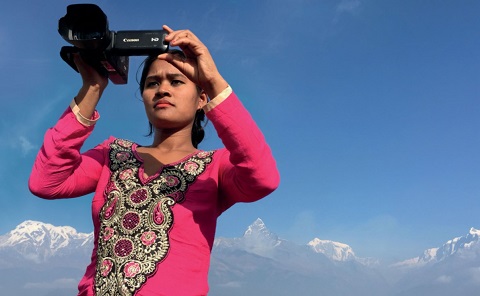
When Belmaya Nepali, a low caste Dalit woman from Nepal, was fourteen years old she was given an opportunity that should have changed her life. An orphan, she was living in a girls' school where she was taught by strict masters, having run away from her home which she shared with her older brothers; they cared little for her education, believing girls to be destined for one thing, a domestic existence bringing up children. Sadly, that was an opinion shared across the patriarchal society of the nation, though when one day British filmmaker Sue Carpenter arrived to distribute cameras to the girls as a project, Belmaya saw a way out...
It's a life of ups and downs to say the least, but as the director credits to this documentary indicate, Belmaya was able to turn her dreams of making films into a reality. Yet that credit is more complicated than that, as Carpenter wanted to give her equal billing since she had guided the production, yet it was Carpenter who was the reason it was made at all. For that reason, some may have been wary of this film, a story of a white, Western filmmaker staging an intervention to rescue a poverty-stricken Asian; suspicions that Carpenter was boosting her profile off the back of Belmaya may have derailed the reaction before the film was widely seen.
However, if you watched I Am Belmaya, you would see this was no simple act of charity, it was a genuinely felt move to give a voice to someone whose circumstances had disadvantaged them. When Carpenter caught up with her subject in 2014, the Nepalese woman was in a bad way, trapped in an unhappy marriage with a vulnerable toddler to look after, and no path out of this to better herself - filmmaking could not have been further from her mind. Nevertheless, a camera was given to her, a place on a new course was found, and suddenly, with access to a method of expressing herself, Belmaya was finding a new power simply by telling her own life story.
Hence the co-director credit, she really did shape the journey of the film as well as taking care of the technical side by operating the camera in many scenes and choosing what was to be recorded, all in the service of her real interest, promoting girls' education in Nepal, and across the world. There was a selfless quality to the documentary in that way, for she led by example, her engagement with society rekindled by use of technology – you can criticise people taking selfies or obsessively filming any bit of trivia around them on their phones, but Belmaya was applying that for good intentions, not out of vanity but out of a altruism. The thought that someone this disadvantaged was determined to improve the lot of her gender globally was truly affecting.
We get to know her very closely, as Carpenter took a back seat to attend to editing the hours of footage together, but while there are setbacks and scenes where she grows tearful at the abuses she has suffered, including a violent husband who refuses to divorce her, and the 2015 earthquake where she pitched in to try and rebuild the devastated community, overall the mood was positive, especially in light of how this resolved itself (which you can kind of anticipate, but that doesn't make it any the less cheering). Belmaya's saucer-eyed daughter was the main reason we could tell the years were passing, as she grew noticeably older the further the film progressed, and she threatened to steal the show with her antics, yet also because she was emblematic of a future her mother desperately wanted to be better for girls like her. With stories of Dalit women suffering still making the news at the time of release, you hoped that Belmaya was going to forge the difference she deserved, for all her countrywomen. Music by Marie-Anne Fischer.