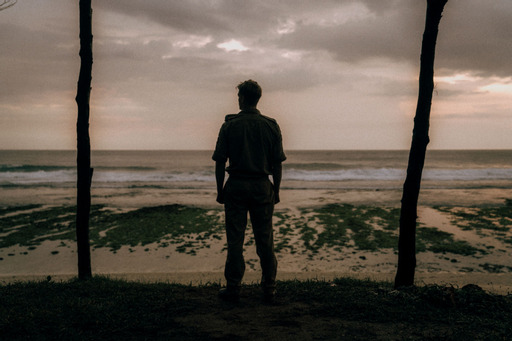
Johan de Vries (Martijn Lakemeier) did not receive a hero's welcome when he returned from military service in what was in the late nineteen-forties known as the Dutch East Indies, but now would be called Indonesia. He found that some of his fellow Dutch were accusing him and his fellow soldiers of being Nazis, or Nazi collaborators, because of the controversies of the Second World War and more pertinently to his experience, the troubling history of The Netherlands in that large region of Asia, but Johan's deeds there are more complex than simple good versus evil. He believed he was doing good in that location, despite the horrors he was witness to as the vicious rebels tried to gain independence for themselves, and the Dutch's colonial crackdown...
Some - even many - conflicts are difficult to sum up in basic terms when there are so many variables that you could fudge or misrepresent, or simply bring up facts that were disputed or controversial. This is what the makers of The East, or De Oost if you were Dutch, discovered after their film was released: many audiences were not at all happy with what they either highlighted or invented for dramatic purposes, and it was a problem that dogged co-writer and director Jim Taihuttu's good intentions of having his countrymen face up to the issues of colonialism in Indonesia and their part in it, while also, being of Indonesian descent, having that nation's bloody past considered as something troubling rather than something worth celebrating. It seemed he could not win.
On one hand, Dutch viewers queried just how far the war atrocities had gone and whether this effort was in any way accurate, while others would have far preferred to see the story from the local point of view and felt this was sidelined in favour of a typical white man's guilt narrative that did not illuminate either the larger politics of the situation, nor the human cost of emerging from those politics. It was true to observe as it stood the plot was like three films in one, first a kind of variation on The Virgin Soldiers, where the naïve but brash new recruits try to establish themselves in foreign climes yet find the place not as welcoming as they would have liked, second a Heart of Darkness with its very own Kurtz, here Dutch war hero Raymond Westerling (Marwan Kenzari), and last, most improbably, a Rambo action adventure where Johan goes rogue.
There was more: flashforwards to Johan's return home where he struggled with the shame of having a Nazi for a father, and decided to hunt down Westerling for revenge (oddly, the detail that Westerling had become an opera singer was true). Yet for some reason the scene where Johan meets his father in prison to bluntly tell him his wife had died, and his father breaks down in tears, held more emotional impact than any of the scenes where Indonesians were executed or otherwise abused by the Dutch troops, possibly because all these years of watching Vietnam War movies where the supposed good guys are confronted with the notion they might not be as good as they hoped had numbed us to the plight of the ordinary folks who were caught in the crossfire. Every so often there would be a bit where an insight was offered, but they were scuppered by the ridiculous melodrama of the latter stages, leaving the impression of a project that got out of hand, and must overall be judged a brave try at best rather than a success, qualified or otherwise. Music by Gino Taihuttu.
[Blue Finch Film Releasing presents The East on Digital Download 4 October 2021.]