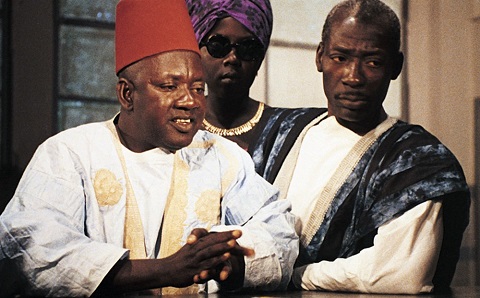
The postman is here, and he has a letter for Ibrahim Dieng (Makhouredia Gueye) which his two wives, Maty (Ynousse N’Daiye) and Aram (Isseu Niang) are very interested to open for him when they are told it has come all the way from Paris in France to their part of Dakar in Senegal. The postman is able to tell them that it contains a money order of a substantial amount; certainly, for Ibrahim it could improve his lot as he has been unemployed for some years and as he is not getting any younger, this money sent by his nephew will be very welcome. But with more money, there's more problems, as firstly, his wives start to spend it...
And they have not even cashed it yet. Senegalese director Ousmane Sembene was a pioneer of African cinema, a writer who reasoned that the movies were the ideal medium to tell his stories since anyone could watch one and have a good idea of what was going on, whereas his literature tended to exclude many Africans when literacy was a problem. He made Mandabi in both French and Wolof, two languages he spoke, making it probably the first film to be produced in an entirely African language, and thus history was made. It was not his first film, however, as he had garnered international attention with Black Girl earlier in the decade.
That, however, had been a monochrome effort, and Mandabi was presented in rich colour that only a sixties film would have as a matter of course, something to do with the film stock they used, but the vibrancy of the imagery even in the most mundane of scenes went some way to sustaining the attention. What was pleasing was the story had lost none of its relevance, so despite parts of it looking decade specific, Sembene's critical takedown of the hypocrisies and corruption of the society he lived in were as keen as they ever were, all tied in with his scepticism of the benefits of the colonial world Africa was struggling to rid itself of, and may still be.
The main gift colonialism had offered his continent, as the director saw it, was bureaucracy and plenty of it; the French may have ostensibly left, but as our hapless hero discover when he goes to cash that order, he needs his papers to prove he is who he says he is, yet he has never needed an identity card before, and fails to see why he needs one now. Nevertheless, Ibrahim opts to try and go along with the system, which leaves him humiliated at every turn as the word gets around he has money on the way and people try to take advantage of him. He tries to be a man of God and do the decent thing, but eventually he has to concede they are exploiting him and the religious charity angle will only take you so far in this life.
But more ironically than that, as he jumps through the hoops the authorities leave for him, he falls behind in debt himself, and what at first was an act of kindness and generosity by his nephew (who we see in Paris in a menial job to get him through evening classes) has become a weight around his neck threatening to drag him under. Now, Ibrahim is not some pure of heart paragon of virtue, and the film makes great play of how he treats his wives as second class citizens, though they are not entirely blameless themselves - nobody is in this, but there are degrees of that virtue and as we see, how far they can be given agency in a world where the dice are loaded against you. Yes, there was a one damn thing after another tone to this, mixed with a little amusement at the predicament Ibrahim is undergoing, but it had a cumulative power as his final revelation had us all realising there is no way to win at this game.