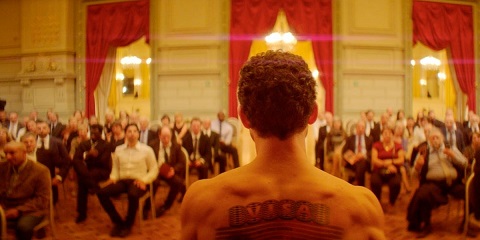
The internationally revered artist Jeffrey Godefroy (Koen De Bouw) is hanging one of his artworks in a prestigious gallery, but it is no ordinary piece, for it is a framed rectangle of tattooed skin. He designed the tattoo, and because of that it is worth a huge amount of money, but what happened to the man who originally was given the artwork to display on his own back? To understand that, we must go back in time to when Sam Ali (Yahya Mahayni) was a struggling Syrian refugee thanks to a stunt he pulled on a train when declaring his love and hopes for marriage for his girlfriend, Abeer (Dea Liane) which got him into hot water with the strict authorities. This is the reason he has to leave, split from Abeer and trapped in the existence of the immigrant...
You can guess what happens next, Godefroy makes him an offer when he is visiting his gallery to help himself to the free food: how about I tattoo you, and you'll never want for money again? It's an offer he cannot refuse, as they say, and soon he is under the needle having an abstract item inked on his back, which by no coincidence resembles some form of currency. Surprisingly, this was based on a true story, though one with less radical implications in real life - the human canvas there simply has to show up to a gallery, whip off his shirt and sit about for a few hours every so often. But the director and writer here, Kaouther Ben Hania, used the idea as a trigger for a debate on human rights and how far a refugee actually owns their own selves, their own bodies.
Is this financial arrangement a form of slavery? Godefroy comes in like an eyelinered comic creation, pretentious as Hell only not funny, a parody of a modern conceptual artist, yet the matters he brings up are perfectly serious. Ben Hania had a looser control on the material than you might have wanted, as for every punch she lands there are two that go wide, and perhaps the stuff with Abeer, where she has been forced to marry a businessman and move to France in the absence of Sam, came across as soapy melodrama rather than the tug on the heartstrings that was intended, not to mention the tearful video conferencing home to Sam's mother which laid things on, if anything, even thicker. The commodification of the body was a more fruitful path to travel down, especially when seemed as though the director was doing precisely that to her star.
There was a peacock quality to the leading man (also seen with an actual peacock) that Ben Hania exploited, as he spends over half of his scenes with his shirt off to show off his well-toned torso, and the feeling the director had been ironically caught up in both using that as her theme and being entranced by a buff male body was rarely far away. This cultivated musings over whether using a body to make an artwork with was any different from using actors to make a film - they sell their bodies and images, or at least hire them out, for other creatives to manufacture an artwork or entertainment and the moral parameters of that only occasionally arise in the critical conversation. The difference here was of course that Sam is stuck with his role for the rest of his life and has no choice in the matter thereafter, though that does not explain the introduction where we see he has been separated from the tattoo. But you would expect the filmmakers to be more interested in the refugee angle, which does not leave much room to explore the grotesquerie of the situation, as Roald Dahl did with his anticipatory short story Skin: he beat them all to it decades before. Music by Amin Bouhafa.
[THE MAN WHO SOLD HIS SKIN - UK RELEASE - 24th SEPT 2021.]