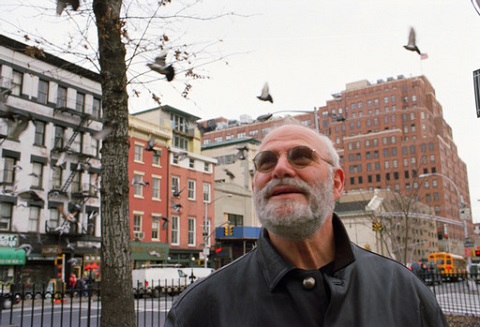
It is early 2015, and Dr Oliver Sacks has received some bad news: he has a cancer that is spreading, and though its progress can be slowed, it cannot be halted or placed in remission, therefore he must face the fact he is dying and will not see the end of the year. He takes this with remarkable cheerfulness and acceptance, more intent on keeping his affairs in order and making sure he completes all he wishes to write about, for if he has one passion in life it was writing. Documentarian Ric Burns has offered to make a film about him, which he has agreed to, and they will spend the next few months Sacks has left summing up his existence and at times controversial contribution to the field of medicine and treatment of patients...
Sacks' problem was that he liked people. A lot. Although a shy man, he was happy to seek out the company of those who had been marginalised either through mental illness or mental incapacity in some degree, since he believed these people deserved to be listened to as much as anyone "normal". Why was that a problem? It was because the medical establishment were more likely to approach the patient not as a friend, but as a kind of object to be diagnosed and supplied with medication or whatever other assistance they needed, that Sacks was regarded as a kind of enemy within, and his literary career, where he collected accounts of his patients and reproduced them for the interested public to appreciate, was damned as exploitation.
You have to say, after watching Burns' documentary, Sacks did not come across as an exploiter, if anything he is more of a victim who saw a method of enabling other victims to have their voices heard. This saw him opening up about his private life in a manner he had not really been content to before, so we learned about his early years as a child of brilliant physicians, then the anguish of the war years where the children were evacuated and he and one of his brothers suffered a harsh boarding school regime where they were mercilessly bullied. This triggered his brother's psychosis which, it is stated, gave the young Oliver the empathy for the afflicted that he would translate into his medical career, as he refused to see his sibling as someone shameful and to be locked away as his condition took hold. But Oliver was having his own personal issues as well.
This is because he was gay, and at a time when such a gender was punishable by law, not to mention the danger of admitting such a thing in public, he saw his only escape to run away to study in San Francisco, which sounds like a cliché but he really did it. There he decided to improve his body as a way to improve his mind, getting into weightlifting, but as far as love went, he shied away from it, channelling his affection into looking after the patients in such a sympathetic manner that he infuriated the orthodoxy. He comes across as perfectly affable here, but when you hear about his inner life (including a spell as an amphetamines addict) you realise what a deceptively complex man he was and as he stuck around and the writing took off, his style of behaving as if the patient in front of him was not a collection of symptoms but a three-dimensional human being, even a dementia patient or one paralysed with little opportunity to communicate, or an autistic who is shunned for their differences, became the recommended manner across the health world. It could be that Sacks' charm was a mask for personal credit as his detractors had it, but watching this you simply come away believing he was one of the good guys.
[Oliver Sacks: His Own Life in UK & Irish cinemas for a One Night Only special event on 29 September 2021. Visit altitude.film for more info: Click here.]