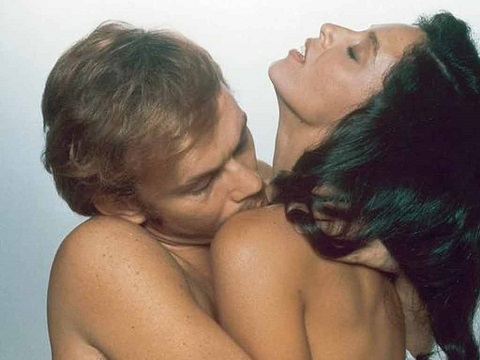
Dona Flor (Sonia Braga) has reached the end of her marriage to Vadinho (Jose Wilker), though not through choice, as one day he was partying as part of a street parade, when the strain on his heart grew too much and he collapsed and died, all of a sudden. Flor was shocked, understandably, and in tears at this upheaval in her life, but the more she thought about him the more she wondered what was so great about this guy anyway. All his fellow gamblers and womanisers are paying tribute to Vadinho at his funeral, but she sees some of the younger women also tearful and begins to judge her late partner as just not husband material in retrospect...
Apart from one aspect, which Flor must admit she will miss: he was great in the bedroom. And not just there, he was so randy he would be up for sex anywhere, and not only with her, either. There then follows around an hour of flashback so the audience can trace the history of their marriage, and judge Vadinho for themselves, as we do not see much of him in the opening ten minutes thanks to him keeling over. Nevertheless, we can surmise he was something of a rogue, and the rest of the first half does not disabuse us of that opinion, for if it's female and attractive, he will shag it, and if it's in any way worth any money, he will gamble it away with enthusiasm.
Since we get the measure of this charming but nasty piece of work early on, despite being billed as a comedy, Dona Flor and Her Two Husbands was not exactly hilarious, and you had to wait for the second half for anything resembling the chuckles to arrive. It was based on a bestselling Brazilian novel by Jorge Amado, set in the nineteen-forties, and was picked up to adapt by twenty-one-year-old Bruno Barreto in a striking statement of intent: the political climate in Brazil was, shall we say, a conservative one, thanks to the fascist dictatorship running the country, though oddly their censorship did not extend to the depiction of sex on the screen, preferring to ban dissent instead.
Once word got out that this film was as steamy as Barreto could have made it, it quickly turned into an enormous hit in Brazil, packing them in in the nation's picture palaces with many return visits ensuring it became the most successful film out of that territory ever. And not only there, as it was their most popular exported movie ever too, gaining traction in that decade of the seventies where the sexual revolution had liberated a generation of being a great date movie as it was practically guaranteed to get the prospective partner you were attending it with "in the mood". It is difficult to think of an equivalent for the following century, as even the Fifty Shades of Grey movies were marketed at women rather than couples, and by now most people preferred to keep that sort of thing behind closed doors where they could appreciate it in private.
Would Dona Flor and Her Two Husbands have the same effect on audiences now? Certainly there's no doubting Vadinho's prowess as Wilker goes at the sexual stuff like a man who knows what he's doing and is quite happy to show it off, and in the second part when Flor remarries, the twist is that her new husband, Teodoro (Mauro Mendonca), is such a safe, polite bet that he may not gamble her money away or beat her, and she appreciates that, but between the sheets he's a cold fish. Flor misses that erotic fire of her unsavoury first spouse, so a solution is found that plunges the story right into the realms of fantasy. If you don't know, it's probably because you don't know the film and this may come as a surprise, if you do, even if you have not seen it this will be down to the ending being the most famous part of the movie by far. No spoilers, but the spirit of compromise bulldozes any bad taste, and if the film takes it sweet time getting there, there's a subversive, celebratory quality of its female sexuality that even now we have not caught up with. Music by Chico Buarque and Francis Hime.