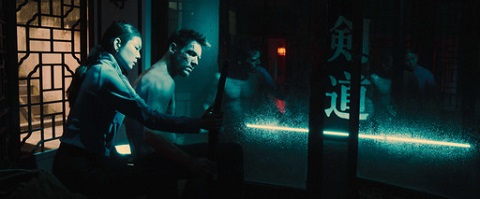
When Akemi (MASUMI) was but a baby, her family was massacred by a rival yakuza clan, and though she was rescued from her mother's arms, she was spirited away to the other side of the world, Sao Paolo, Brazil, which is home to the largest community of Japanese outside of Japan. Twenty years later, she has little idea about her past, and works as a street vendor selling food while she trains for her martial arts expertise. Meanwhile, in a nearby hospital, a man (Jonathan Rhys Meyers) awakens in bed and wonders where he is, having been delivered there badly beaten and cut up, but what he does know is that he has no intention of staying there any longer than he needs to. Therefore when the staff try to restrain him, he grows violent...
Well, everybody grows violent in this film, a Brazilian version of a yakuza thriller the Japanese would make as a matter of course, and had done for over half a century by the point this was released. The novel location was very cinematic after the Japanese style of street design with its neon and hubbub, and transposing that to Sao Paolo was reminiscent of what Ridley Scott did with Blade Runner back in the eighties, except here those were genuine places and not augmented with flying billboards or whatever. This was based on a graphic novel, and you could tell, thanks to its switching between its action sequences and its dialogue, delivering much philosophical musings on the subject of how much you should bear the grudges of your elders when you feel this is not your fight anymore.
Only if Akemi did that there would be no real story, so she spends most of her time with her samurai sword as a companion, always ready to draw it and pose with the blade, again a cinematic image that director Vicente Amorim was happy to have her do to an almost redundant degree. Meyers, meanwhile, unsure thanks to his amnesia whether he is on her side or not, shadowed her and got the better of the yakuza who are trying to track her down - we know who's a yakuza because they are always opening their shirts to reveals intricate tattoos across their torsos. After a while you get the idea that Amorim had a handful of tricks up his sleeve and my goodness he was going to use them as often as he could over the course of the nearly two hours it took to tell his story; cut out the chit-chat and you would have had a leaner experience.
Meyers did give his fans an eyeful with a full-frontal nude scene, while pop singer MASUMI in her debut movie, decided against such a brazen display, and though they were the leads there was no question of their characters getting together on a romantic level. The other main player was one of the older yakuza who just cannot let the grudges go, to everyone's detriment, Tsuyoshi Ihara as a character called Takeshi (there was wishful thinking), but he turns protector for Akemi as well, though she has the skills with her sword to mostly look after herself, albeit presented in the fast-cutting manner that would make anyone who could do the poses look effective. Though you were reluctant to say it, it did look as if the filmmakers were keen to court memories of Quentin Tarantino's Kill Bill, it had that Westerner's eye of Far Eastern culture tone to it, which would explain why the action was dragged down by all that talk which you likely would feel was holding up the plot getting anywhere. When it did reach its destination, you were not exactly shocked at how it had turned out. Still, Japanese Sao Paolo did have a great appearance. Music by Fabiano Krieger and Lucas Marcier.
[Signature Entertainment presents Yakuza Princess on Digital Platforms 13th September 2021.]