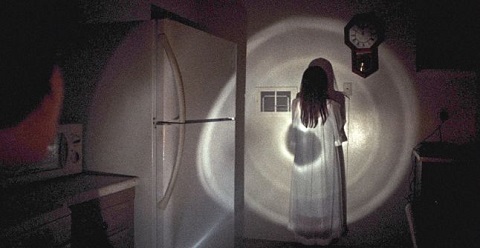
Dylan Jacobs (Ezra Dewey) is a little boy who thanks to an accident had to have an operation that robbed him of his power to speak. He is convinced this is why his mother is no longer around, and he is now living in a new apartment with his father (David Brownstein) as sole guardian, but weighed down by guilt, Dylan would do anything to be reunited with his mother. When one day he finds a book in a cupboard, left by the previous owner, he is intrigued since it seems to provide him with a solution to his problem: its subject is djinns and how to summon them and have them do your bidding. Although the text warns of unforeseen consequences, Dylan knows he can handle it, after all, what could be more innocent that asking for your voice back?
Directing team David Charbonier and Justin Powell had worked with younger stars before on their first feature, the horror thriller The Boy Behind the Door, but this time these was just one of them, and he was more or less in every scene, a lot to ask of a performer of such tender years. Add to that the plot necessity of not being allowed to speak, and it must have been the source of some pressure, yet you had to say Dewey did a pretty decent job, OK, in after about twenty minutes he was spending most of the storyline running away from the djinn's apparitions that apparently wanted to tear the voice out of Dylan, but he managed to sustain at least a basic level of tension from what he was given to work with, and proved a protagonist who had some sympathy.
That was despite his poor choices, which you could excuse more in a ten-year-old boy who did not know any better than you would in an adult who had more experience, and possibly would not swallow the idea of a book that gave you access to Middle Eastern spirits to potentially solve your problems. There is no quick fix to some issues, indeed there is no quick fix to most issues, was the warning the film had for its audience, and while this was not a children's film, it did come across as a compact morality tale that would not be out of place in a child’s storybook. Not for nothing did the father read his son a bedtime story of Pinocchio, to underline that fairy tale with a lesson tone to the piece that could have, by leaving the more brutal violence out, easily have been a horror movie for the under twelves, in the vein of something like R.L. Stine.
Oh, and take the suicide references out as well, as it transpires Dylan's mother shot herself in the head, maybe because of depression that her son was powerless to do anything about. That was the heart of the story, giving power to the powerless, but also how they will be ill equipped to deal with it, implying they were powerless for a reason, possibly a rather conservative view of the self-enabling narrative in that if you did have the ability to make your life better, you would only mess it up anyway. Not that Dylan stands much of a chance after he has conducted the ritual and the point is to survive the night as he is assailed by an escaped convict and a twisted version of his dead mother. His father is a late night DJ who is not in the apartment, thereby offering our misguided hero the opportunity to get up to all sorts of mischief in the name of improving his family's lot. For some reason this was set in 1989, seemingly so Matthew James' soundtrack music could be heavy on the synths, but also so there were no mobile phones to get in the way of the plot twists. It did limit itself rather a lot, but as an exercise in style it was neatly achieved.
[The Djinn is released in cinemas and on digital on Friday 17th September 2021.]