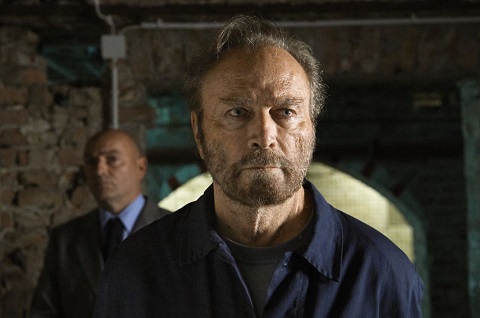
2001, and Caspar Leinen (Elyas M'Barek) is a young German barrister who is three months out of graduating from law school and already has one of the cases of his life to defend. This happens after an elderly man (Franco Nero) ventures up to the offices of a top CEO and while they are alone together, emerges a minutes later splattered with blood and asking to be taken into custody, for upstairs the murdered corpse of the CEO is discovered, shot by an old German Army weapon. There are complications already: Caspar knew the dead man very well, having been practically brought up by him after he met his son as a boy, and it was his idea for Caspar to enter law school. But as they are not blood relations, there is deemed to be no conflict of interest...
Loosely based on a true story, this was obviously a prestige picture for the German film industry, dealing as it did with the nation's grim past in the glossiest manner possible, and closely resembling the sort of classy television drama you would often see on a Sunday evening. Indeed, if you split it into two parts you would easily have a couple of episodes of a miniseries that would fit snugly into the schedules of any high-end TV channel's schedule; there were even breaks to black in the course of the story where advert breaks could go quite easily. It was evidently intended to be taken very seriously, dealing as it did with the aftermath of the war crimes millions were deeply involved with, and how they were in effect allowed to get away with these crimes by dint of a legal loophole.
Actually, it wound up not being so much a loophole as an actual law, something the film regards as a scandal not enough Germans acknowledged back in 1968 when it was passed, and certainly not decades later when the country thought they had moved on and were putting their past behind them. The Collini Case did not so much seek to dig up that past and ensure it was remembered and respected inasmuch as the victims were remembered and respected, which it did in the framework of a courtroom drama cum legal thriller, with Caspar the wide-eyed innocent learning about all these terrible incidents and finally seeking justice for the elderly assassin, who turns out to be the Italian Collini of the title. So as far as its noble intentions went, it was hard to argue against its sense of purpose and righteous indignation about the older generations.
What was easier to argue against was the style in which it was delivered, playing it safe at every step of the way, and rendering a potentially incendiary subject matter somewhat academic and not too easy to engage with. By making Caspar a young man of Turkish extraction, presumably they hoped to bring in the racial element, but you did wonder, to what end? Would it not make it more satisfying to have the defence of Collini led by the son of the murdered man so that the revelations would hit home all the tougher? But it is presented at one remove from the heart of the matter, certainly Turkey has its own troubled past, and one with Germany too, but it seemed there were too many aspects being mixed up together in director Marco Kreuzpaintner's approach, all held together with that slickness containing a superficiality that did the harrowing details of the crimes of the Second World War a disservice, or at least a disservice to the victims. Wrapping this up in chocolate box colours was a dubious choice all in all. Ben Lukas Boysen.
[THE COLLINI CASE - In cinemas 10 September 2021.]