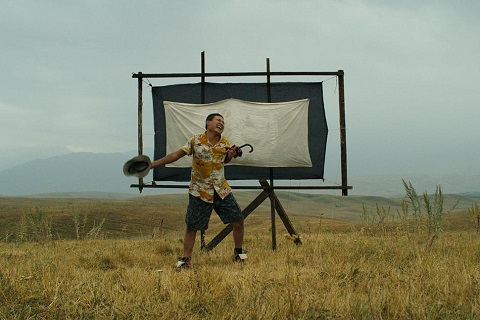
Kermek (Azamat Nigmanov) is just out of prison and seeking a job, but while he manages to secure one without much fuss at a diner on the Russian Steppes, he reckoned without his brother, a cop who barges in and berates the staff for giving him a second chance, because according to him Kermek will just rob them. No matter that the eternally optimistic fellow wanted to prove himself worthy of the straight and narrow, since his big dream is to build a cinema in the hills, where he owns a small plot of land, his troubles stem from the fact that everyone with any kind of occupation is connected to the local gangsters, who control everything...
Yellow Cat was another movie hymn to the power of your dreams, but as a Kazakh film it was a lot less convinced of that than your average Hollywood effort, preferring to shatter its protagonist's ambitions and show him up as hopelessly naïve if he thinks the way the world works is anything that would benefit something so positive as the escapism he finds from the silver screen. Quite apart from the matter that opening the theatre does not comes across as the most lucrative of business propositions, so there was no guarantee Kermek would make any money out of this enterprise, the bad guys are simply too powerful, despite being strictly small time.
Kermek has a party piece, in that he idolises Alain Delon and can recite - and act out, but no spoilers - scenes from Le Samourai at the drop of a hat. Or alternatively, while wearing a hat - his trilby is the only real concession to the Jean-Pierre Melville cult classic, for the rest of his never-changing ensemble is as if he's dressed for a day at the beach in Hawaiian shirt and shorts. We learn this attachment to Delon stems from seeing the first hour of that movie over and over in the orphanage he was staying (or left) in as a child, an hour was all they were allowed to watch, so he has no idea of how the story ends and you wonder if he ever will be able to clear up that personal mystery.
What writer and director Adilkhan Yerzhanov was doing here was his own tribute, but only partly to Melville, as that quotable cineaste's cineaste Quentin Tarantino hoved into view. Yes, this was a take-off on one of his movies, not so original when most indie thrillers from the mid-nineteen-nineties onwards were precisely that, but perhaps not taking the obvious route when Kermek was plainly intended to be Christian Slater's character from True Romance, itself influenced by Terrence Malick's Badlands. And of course, Christian needed a girl to help him through his predicament, so our hero gets someone similar, the pixilated prostitute Eva (Kamila Nugmanova), a vacantly cheery, doll-like presence who he connects with.
Naturally, they go on the run, with the gangsters chasing after them, still with Kermek's dream of opening that movie theatre keeping them going, but there was something you could either categorise as brutally realistic or sadistically anti-romantic about how the lovers (if they even get as far as being lovers) are consistently taken down a peg or two or more by the other characters and, by extension, Yerzhanov himself. He was no stranger to crime thrillers, but this was supposed to be a comedy, though it was only intermittently laughter-inducing, but when it was it reminded you that the most violent bully could be goofy in their way. Mostly you were watching this waiting for the sky to come falling in on the couple, and while there may have been an interlude where Kermek re-enacts Gene Kelly's signature dance in Singin' in the Rain, that could merely be designated as a stay of execution. The sweetness of the pair were no match for the cold, harsh, bitter truths. For that reason, you may prefer the movies. Music by Ivan Sintsov and Alim Zairov.