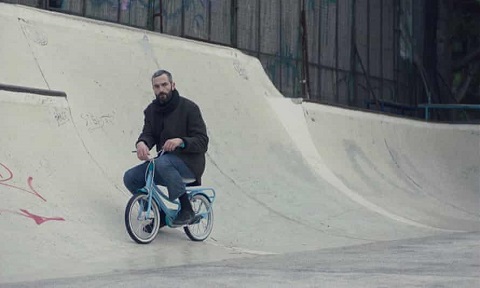
You know what it's like. You've spent the day banging your head on the wall, and staring into space, but there comes a point when that kind of entertainment won't cut it anymore and you have to leave your home. But for Aris (Aris Servetalis), there's a problem. Nobody knows why, but there is a growing epidemic across the city which sees the afflicted lose their memories in a form of amnesia. Not everything goes, they can still speak, or feed themselves, or carry out basic tasks such as visit the shops, but anything about their pasts eludes them, leaving them blank slates where their personalities used to be. Is there a cure? Does Aris even want a cure?
More of a subdued meditation on what makes us human, almost in a nature versus nurture kind of way, Apples was the first feature from Greek director Christos Nikou which had him lumped in with the movement of the Greek Weird Wave, where directors posed surreal, at times disturbing scenarios often featuring social and official institutions twisted out of kilter in some fashion. Here the institution was the medical practice of psychiatry, as once Aris (who has forgotten his name by an early point in the proceedings) comes down with the condition, he is taken to a hospital with other sufferers and has his mind tested to find out the limits of his memory banks.
Stuff like trying to remember objects in boxes, a particular flash card, and so on, before being allocated a small flat where he is given some analogue equipment (nothing is digital in this world) to help him readjust to life. The trouble with that being, he did not seem to be too well adjusted in the first place, living an empty existence that the amnesia has focused into a purpose for himself: listen to the instructions on the tape recorder, take pictures of incidents in his day with a Polaroid camera to present to the doctors as proof of his progress, or otherwise, that sort of thing. This appears to be a far more substantial amount of experience than he was having before.
Then we get the supposedly "normal" but actually strange social conventions Aris is ordered to fit in with. As we are programmed by nature to seek a romantic partner, that is what he is told to do, having to attend nightclubs and fancy dress parties in order to find a mate, who eventually turns out to be fellow sufferer Anna (Sofia Georgovasili), a woman he meets at a cinema showing of The Texas Chain Saw Massacre (she was cowering behind the seats in terror!). Thereafter the film grows into a deadpan parody of a meet cute romantic comedy, indeed the signs are this was supposed to be funny on at least a basic level, or at least funnier than a Yorgos Lanthimos movie at any rate (Nikou was a former assistant director to the Weird Wave pioneer).
Presumably the viewer was intended observe all of this and nod appreciatively or chuckle indulgently at what it had to say about relationships, or the expectations single people must endure amid the pressures of the new millennium, especially when they don't fit into an increasingly narrow field of social expectations which according to this may trigger a muted apocalypse. If anything, it was too muted, with the emotions dialled down low and many could have some trouble latching on to much here that they could relate to, or want to relate to, the science fiction element content to settle for a parallel world that could be achieved with the minimum of effects or props. As for what it said about how our personalities are constructed from memories, Aris displayed such a subtle range of characteristics that you could be forgiven for thinking there was no there there, before or after the pandemic. Yet oddly, it was so quiet that it was a soothing watch, in the kind of way that when the worst has happened, you achieve a kind of acceptance for the situation. Music by Alexander Voulgaris.