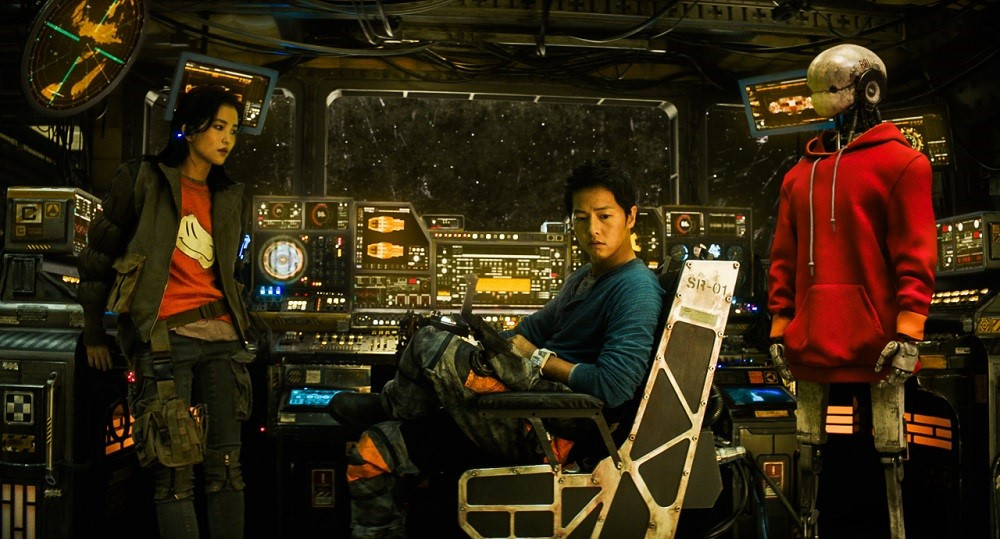
In the year 2092 Earth is almost uninhabitable. Led by visionary tech billionaire James Sullivan (Spooks star Richard Armitage), the powerful UTS Corporation oversee humanity’s escape to a new orbiting home. On this artificial world designed to mimic Earth's natural environment, inhabitants are among a chosen few while non-citizens are strictly regulated by UTS via a set of oppressive laws and taxes. Meanwhile space is full of dangerous floating junk like discarded satellites and abandoned spaceships. Down-on-his-luck former UTS tech specialist Kim Tae-ho (Song Joon-ki) makes his meagre living as a "space sweeper." Along with crewmates Captain Jang (Kim Tae-ri), grizzled engineer Tiger Park (Jin Seon-kyu) and Bubs (Yoo Hae-jin) the wiseass robot he harvests space debris floating in Earth’s orbit and sells it to the company. For all their efforts the hard-working but luckless space sweepers can't seem to catch a break. Particularly Tae-ho who struggles to scrape together the money he needs to find the daughter he lost in space. While hauling an abandoned spacecraft the crew discover a passenger hiding aboard, a little girl named Kot-Nim (Park Ye-Rin). Media reports suggest Kot-Nim is actually Dorothy, a robot weapon of mass destruction constructed by the terrorist group Black Fox. But when Tae-ho and the others try to ransom the child for a huge payoff they discover she holds the key to unravel a conspiracy threatening humanity's survival.
An impressively realized South Korean sci-fi blockbuster with an engaging, warm-hearted yet at the same time darkly satirical story , Space Sweepers stands as the most ambitious Asian space opera since Message from Space (1978) in terms of scale. Thematically it easily outpaces that fun but pulpy Japanese production. On a purely technical level writer-director Jo Sung-hee fashions a gorgeous-looking, densely realized production with spectacular sets, visual effects and high-octane space action sequences equal to any recent Hollywood effort. Equally impressive is Sung-hee's deft handling of an international cast to envision a multi-ethnic, multilingual future that grounds this fantastical futurescape in a plausible reality; seamlessly melded with a sense of cosmic wonder and heart often lacking in mainstream SF cinema.
It should be noted though that Space Sweepers is indebted to Joss Whedon's short-lived but influential TV show Firefly along with its companion feature film Serenity (2005). The film echoes Whedon's space western with its band of rugged, deceptively venal survivalist heroes, philosophical discourse on humanity's reckless mistreatment of the environment (which extends to littering space with abandoned tech) and portrait of a capitalistic future world where politics has become hopelessly corporatized. Jo Sung-hee envisions a corporate-controlled dystopia where even one man's grief and desperation can be commoditized and dehumanized, driving Kim Tae-ho and his compatriots towards self-preservation and harvesting money above all else. That is until Kot-Nim with her wide eyed innocence and adorable little bowl-cut reawakens the last vestige of empathy and kindness dormant in the hitherto money-driven characters.
Despite the occasional logic hole and a tendency to let weighty philosophical observations lapse into florid comic book speeches, Space Sweepers assembles a tight, compelling story. One that skillfully balances is cynical observations about the corporatization of society with heartfelt belief in the triumph of honest, goodhearted working people, moments of genuine tenderness between well-drawn characters and slapstick gags that are laugh out loud funny. It also makes a sly observation that global corporations are pushing humanity into space mainly because it is more profitable than trying to save the Earth. It is a point all the more unsettling at moment in time where so many billionaires are obsessed with going to space.