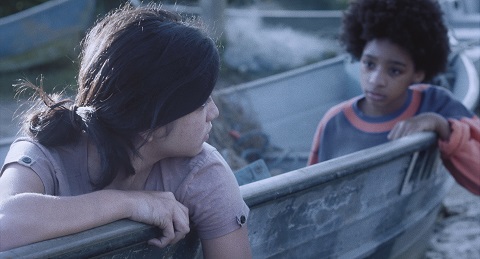
Nana (Amanda Yamamoto) is a Brazilian girl in a fishing village growing into adolescence, but she has learned to be wary of the men in the area, for they are the types who will take by force what they cannot get by asking. One day, a strange creature is caught in one of the men's nets and it causes great interest among them, since it resembles a woman, but also a fish - when one of the men tries an intimate examination to find out which, his finger is badly bitten by something down there.
Lillah Halla is a Brazilian filmmaker with specific interest in the rights of women and girls, and this short saw her exacting revenge on those men who go too far to reach their satisfaction, using the old legend of vagina dentata to put her point across. Presumably we are intended to think, "Serves you right!" when the fisherman goes as far as he does to ascertain whether the mysterious, barely alive body they have dragged up from the depths is female or not and gets his fingers chewed in the process.
This fascinates Nana and her friend, who see a method of preserving their virginity now those men are taking an interest in them - although it had to be said, the girls did look very young, which added a layer of perversion to the potential for assault they are concerned about. What the pair want to know is whether the teeth the bitten man found were a natural part of the fish woman's body, or whether she had concealed a piranha up there and that was what did the actual biting, as a form of protection.
Piranha are rife in the waters around the village, we see shoals of them to indicate the place is thick with them, but since the girls are not fishy mythological creatures, they put two and two together and invent a solution to warding off the threats of rape, which leads us to the punchline which may remind some horror fans of the earlier feature film Teeth, which generated a cult following over ten years previously. Menarca was a short, however, and took around twenty minutes to tell its tale in compact fashion, though some may find it hard going despite its relative brevity and succinct qualities.
This was because Halla chose to film her story in the most obscure manner she could, leaving her imagery as a series of tight closeups for the most part, and shot in a blue-grey gloom that did its no favours in the realm of narrative clarity. It was such a simple, if macabre, piece that you were not likely to lose the thread completely, but you did wonder if there was any need to render it as quite as much hard work as she did. Whatever you thought of the twist in the tale, and it was pretty satisfying despite the style in which it was presented, that style may be a deal breaker even more than the angry feminist message that could put the more sensitive (or self-righteous) male viewers off. Female viewers may have a different reaction.