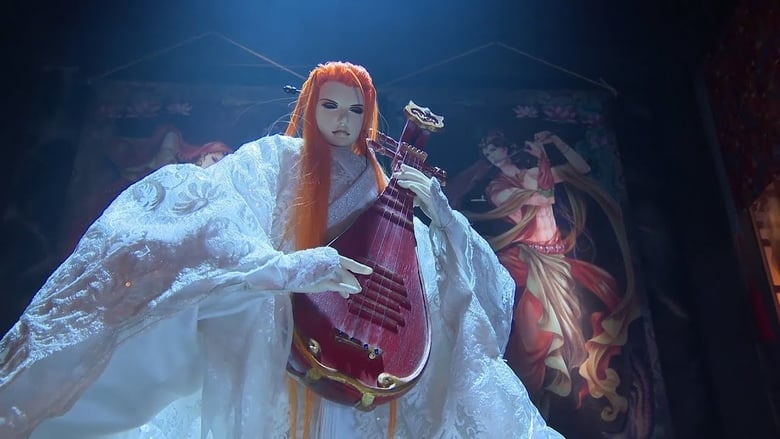
Long ago in ancient mythical China, flame-haired youth Lang Wu Yao (voiced by Takanori Nishikawa) endures the torturous training methods of his blind mother Zhou Xun Jin (Kikuko Inoue). She aims to make him the perfect minstrel and master swordsman destined to play at the Imperial Court. One especially stormy night Lang Wu Yao catches a fever. It alters his voice, albeit for the better, but the shock spurs his mom into taking a fatal fall off a cliff. Poor Wu Yao winds up performing at a remote tavern, secret hideout for the kingdom’s most notorious outlaws. They all flock to hear his magnificent musicianship. One such visitor is beautiful Mutsu (Nao Toyama). She befriends Wu Yao, becoming his confidante, and proves his equal both in musical ability and swordplay. Alas, Lang Wu Yao’s uncanny abilities draw the attention of an ambitious Imperial Magistrate. He raids the tavern then presents Wu Yao to the kingdom's all-powerful ruler: child princess Chou Fu (Rie Kugiyama). The cruel and sadistic Chou Fu loves to have minstrels perform while avoiding the lethal blades of her Imperial guards. All wind up dead, save for Lang Wu Yao. Thereafter he becomes Chou Fus "caged bird", singing soulful ballads and slaying swordsmen, night after night, time and again; seemingly for eternity. Until one day Mutsu appears from nowhere to challenge Lang Wu Yao...
This striking Japanese-Taiwanese puppet fantasy is a feature length spin-off from the hit TV show Thunderbolt Fantasy. Whereas the show dwells primarily on wandering sword hero Shang Bu Huan (Junichi Suwabe) and his sister Mutsu on their quest to destroy a selection of magical swords, Bewitching Melody of the West serves as an origin story for fire-maned fan favourite supporting character Lang Wu Yao. As with anime epics like Saint Seiya (1986) and Ronin Warriors (1989) the primary appeal seems to be sword-wielding pretty boys in fabulous costumes. Both Japan and Taiwan have a rich tradition in puppet theatre that dates back even further than their devotion to illustrated entertainment. In days of old wandering puppeteers delighted audiences both rich and poor with thrilling stories of heroic swordsmen. More recently (well, forty years ago) Go Nagai scored a cult hit with his space-faring robot saga X-Bomber (1980), dubbed and released in the UK as children's favourite Star Fleet, while Taiwanese production Legend of the Sacred Stone (2000) was similar to Thunderbolt Fantasy in both story and execution.
Here Gen Urobuchi, co-creator of genre-redefining magical girl anime Puella Magi Madoka Magica (2011), builds on that tradition. Clever editing and staging imbue the cast of puppet characters with a fluidity of movement that proves remarkably lifelike. Urobuchi and his production team stage the film's abundant action sequences midway between a music video and a Tsui Hark blockbuster, complete with gravity-defying wire fu, swirling camera moves, explosions, energy beams and torrents of blood. Lots and lots of blood. All set to music. Yes, Thunderbolt Fantasy: Bewitching Melody of the West is as much a musical as a swordplay fantasy. Characters burst into song in the midst of battle, ditching traditional balladry for kick-ass stadium rock! Amping up its rock opera exuberance all the way to eleven, Lang Wu Yao also strums his lute as a death-dealing sound wave weapon. In the time-honoured tradition of Hong Kong fantasies like Demon of the Lute (1983) and Deadful Melody (1994). All of which sounds absurd but actually proves quite poetic, underscoring a theme expressed in a speech by Mutsu about learning to transcend darkness and personal pain through the transformative power of art. While Wu Yao admittedly proves something of a leaf on the wind, blown from one mishap to another, the plot has a clear character arc of learning to reject "predestined fate" and forge one"s own path. It ends on a cliffhanger with all the pieces set up for the television series. Behind the scenes footage plays over the end credits and is fascinating in its own right.