Manga creator Kazuo Umezu is the biggest name in Japanese horror. So much so that he remains a huge celebrity and talk-show fixture; always sporting his trademark frizzy hairdo and wacky "Where’s Waldo"-esque red-and-white ensemble. Umezu's stature as a cherished cultural icon is all the more remarkable given his manga routinely showcase graphic images of children disemboweled, mutilated or devoured so extreme even adult-oriented western horror films cannot compare. Even more remarkably his manga are serialized in anthology magazines aimed at little girls, incidentally the most voracious readers of horror in Japan. That said it took decades for Umezu's work to reach the English market. By which time he was eclipsed, in western eyes, by the subtler, more psychologically oriented J-horror fables of lifelong Umezu fan Junji Ito. Umezu's quirky mix of cutesy Disneyesque art and extreme saw clueless bloggers dismiss him as a creep or worse yet, a pedophile.
Screen adaptations of Umezu manga remain a mixed bag, from cult director Nobuhiko Obayashi's flawed big-budget adaptation of his most ambitious epic Drifting Classroom (1991) inexplicably starring faded Hollywood heartthrob Troy Donahue, the sexy sci-fi noir Baptism of Blood (1996) (the most widely distributed Umezu film in America), to Noboru Iguchi's el cheapo take on Cat-Eyed Boy (2006). Interestingly Umezu himself wrote and directed his most acclaimed film: the semi-autobiographical Mother (2014). Compared to this abundance of live action fare there are strangely few anime based on Umezu manga. Easily the most famous would be Makoto-Chan (1980), a showcase for Umezu's atypical albeit beloved comedy character, while The Boy with Cat Eyes (1976) (based on the same landmark manga as the Iguchi film) is notable for its offbeat Clutch Cargo-like mix of still drawings and cut-out animation.
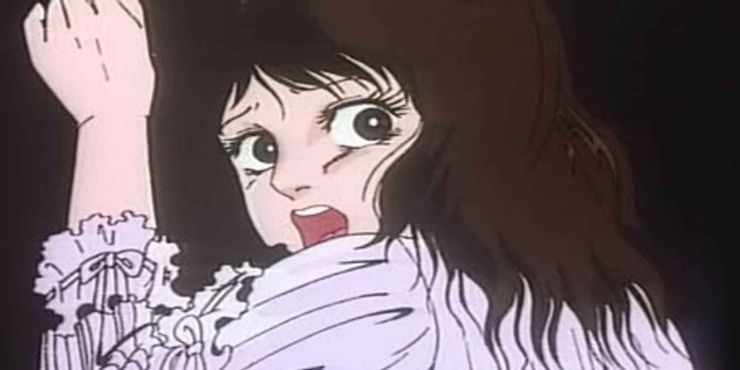
Which brings us to The Curse of Kazuo Umezu, a forty-three minute anthology made by fans as a possible attempt at kick-starting an OAV series. Our narrator, a creepy Tim Burton style Goth boy (voiced by Ikuya Sawaki) warns viewers not to "mess with the supernatural" before introducing the first of two stories. "What Will the Camera Reveal" opens as beautiful schoolgirl Rima (Shinobu Adachi) returns from Mexico to drive her male classmates wild even as she leaves heroine Masami (Naoko Watanabe) feeling very uneasy. Something about Rima's glacial intensity just does not sit right. Caught between jealousy and obsession, Masami is plagued by a vivid nightmare after which she awakens to find an unsettling mark on her neck. With no idea how it got there she calls on a kindly male friend to catch her next night terror on video. But the next morning when Masami watches the tape she gets the shock of her life...
Story number two "The Haunted Mansion" has horror loving friends Miko (Rei Sakuma) and Nanako (Ai Orikasa) rashly break off their scary movie slumber party to explore the spooky old house across the street, accompanied by a couple of disposable friends. One of whom strongly resembles Velma from Scooby-Doo. Given the house was the site of a grisly child murder and remains full of creepy-looking toys, things go about as well as you would expect.
It is uncertain whether these are stories Umezu penned early in his career or perhaps original works crafted especially for this anime. Either way neither is really representative of his idiosyncratic and often profoundly unsettling work. To its credit, the two stories build their mysteries in solid Umezu fashion: slowly, one creepy detail at a time, culminating in big gross-out set-piece shocks a live-action film would require a Rob Bottin like effects maestro to pull off. However, as with much J-horror, it is the quiet moments that truly unnerve. Of the pair "What Will the Camera Reveal" might be the more potent. It almost heads in the direction of quasi-lesbian allegory with Masami grappling with "strange feelings" stirred by the mysterious Rima. Until an interesting twist rewrites everything we just saw. Like The Ring (1998) the plot hinges on a VHS recording with imagery too terrifying for the protagonists to endure. "The Haunted Mansion", while atmospheric with some very creepy visuals, is much more conventional. Essentially a one-note premise building to an effective though nonsensical mind-fuck finale, it does not know when to stop. Neither story is likely to silence critics who charge Umezu with misogyny. Yet one would argue their true failing lies with being slight and disposable where truly great Umezu stories fuel years' worth of nightmares.