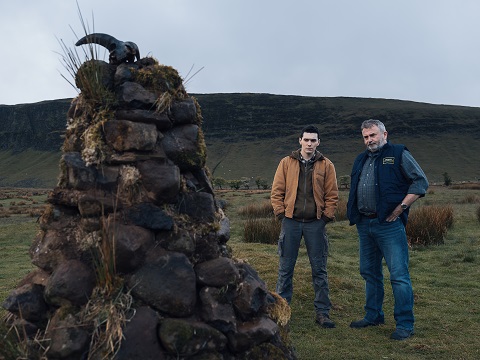
Eugene Moffat (Jack Rowan) is stuck in this go-nowhere village in Ireland, where he was brought up, and has no idea what to do next, as everyone in the place of his generation either manage to leave or get trapped there, as he suspects he may be. The area's only distinguishing feature is a cairn in a nearby field that is supposed to keep the spirit of a legendary vampire from emerging and wreaking havoc; Eugene does not really believe all that supernatural talk, but it's something to distract him when the tourists arrive to check the location out and he and his friends can have a bit of fun. Some very limited fun. But what if there was truth to it?
Like werewolf movies, vampire movies have been done to death (pardon the pun - no, actually, don't) so if you're seeking to make another one, it's only polite to have a different take on the subgenre. In that manner, they were less set in their ways than zombie movies, so afforded a chance to stretch the concepts a little more, add elements that might not entirely fit comfortably with what the audience was expecting, but could give the traditions a little more flavour to the usual neck biting, fear of crosses and stakes, avoid sunlight, must be invited in, and so on business that made up the bulk of the vampire lore. Even, so, by this point Twilight had spoiled things.
That franchise had retooled the bloodsuckers with boy band aesthetics to great success with their target audience, but the knock-on effect on the genre was more debatably beneficial, and as a result there were some backlash efforts such as Boys from County Hell, where writer and director Chris Baugh sought to make vampires scary again. What he in fact made scary was the prospect of living in a place where there was no future for you, and like Eugene's best friend William (Fra Fee) you have to go abroad to get away from the deadening, parochial atmosphere of those out of the way villages where there would not be a hope in, well, Hell of getting better.
Indeed, there was an unexpectedly large concentration of the film's running time given over to the plight of the young in rural or depressed regions, so despite a road being constructed there, Eugene does not expect anyone interesting to use it, though he would be able to get the heck out of there on it if he had the money. Therefore the vampire becomes a metaphor for the way this sort of environment will drain the life out of any ambition you harbour in your early years, though once the blood starts to flow the afflicted do come across more along the lines of zombies of the fast-moving variety which are impossible to reason with thanks to the mania that has overtaken their bodies. Fair enough, it was a shade clunky, but showed there was some thinking behind it.
Besides, once we had established the themes for the audience to take or leave as they saw fit, there was a vampire story to be getting on with, though this took little glee in the infection of the locals, for they were as much a victim of circumstance as the village's younger folks, and the only solace any of them have previously found is in drinking beer rather than the red stuff. Eugene teams up with his dad (Nigel O'Neill), William's barmaid girlfriend (Louisa Harland) and the resident joker SP (Michael Hough) for a night they fear they may not survive, though such a bleak picture of their surroundings has been painted that you may conclude being a vampire would be preferable to being the soulless rural denizen which populates the territory. Baugh's take on the lore was not so much to ignore it, as discount it, a slap in the face to Bram Stoker who the film purports to respect as a reclamation of vampire from Transylvania to Ireland, but the humour carried it. Not wholly original, but original enough. Music by Steve Lynch.
[BOYS FROM COUNTY HELL TO BE RELEASED IN UK AND IRISH CINEMAS ON 6TH AUGUST 2021.]