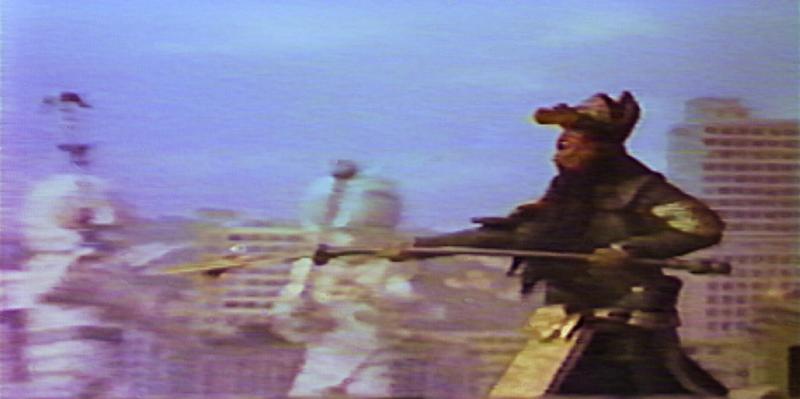
Ageing sculptor Chao (Chen Yu-Hsin) is going blind but remains doggedly devoted to finishing a statue of Chinese warrior god Guan Yu in honour of his late wife. Meanwhile Chao's son Chai Chun (Gu Ming-Lun) is a scientist with no patience for dad’s dedication to art and outdated superstitions. He and his team, including glamorous lady scientist Chun Lan (Cindy Tang Hsin), toil in a space-age laboratory conducting experiments on bees as part of theoretical research into alien environments. Elsewhere Chao's daughter Li Yu (Tse Ling-Ling) is a fun-loving biker gal cruising the streets and - horror of horrors! - dancing at beach parties to Carl Douglas' novelty hit "Kung Fu Fighting"! Whereupon a mysterious force (handily invisible for the benefit of low-budget filmmaking) flings Li Yu into the air. It also imparts in her an hallucinatory vision in which she is chased across a trippy alien landscape by giant bug-eyed Martians!
Before long Hong Kong descends into paranormal madness. A heat-wave boils a swimming pool. Gravity runs amuck floating citizens skyward. Time flows in reverse making planes, people and household pets walk backwards via hilarious stock footage. All of which heralds the arrival of three giant Martians that promptly stomp around town, smashing every building in sight. Why? Er, something to do with punishing mankind's devotion to science. They also disintegrate all the cows and geese. Why? Er, because they are lactose intolerant. I don't know, what do you want from me? Anyway Chai Chun and his white jump-suited science team spring into action, but their laser weapons and scientific know-how prove useless in the face of Martian might. Meanwhile old Chao, between traumatizing his kids by refusing to flee the war zone, piously embraces his wooden idol and prays for a miracle. Sure enough it arrives in the form of a fifty foot tall scythe wielding Guan Yu who promptly kicks Martian ass.
Throughout the Seventies a slew of Chinese productions sought to cash-in on the popularity of Japanese superhero ('sentai') and special effects ('tokusatsu') films. Alongside the likes of Super Infra-Man (1975), Super Riders Against the Devil (1976) and, god help us, Invincible Space Streaker (1977) this Taiwanese-Hong Kong co-production stands as perhaps the most grandiose, not to mention outrageous, entry in the genre. Mixing mythology with science fiction The Big Calamity, a.k.a. War God, also slots into a uniquely Asian subgenre that while often credited to controversial Thai filmmaker Sompote Sands, e.g. The 6 Ultra Brothers vs. the Monster Army (1979), Jumborg Ace and Giant (1974), Phra Rod Meree (1981), was more likely influenced by Japan's Majin trilogy. The film also alludes to the Irwin Allen disaster films of the Seventies with their blend of spectacular destruction and bludgeoning melodrama. It is a long, slow build up to the city-wrecking and monster fights. Not helped by the script’s heavy-handed moralizing.
Indeed the whole plot seemingly exists to put stuffy scientist Chai Chun squarely in his place, not to mention his free-spirited sister Li Yun. That'll teach her to go dancing to disco novelty tunes when she ought to be at home praying. Scene after scene has Chai Chun's scientific rationale falter in the face of Martian madness while his pious papa (who can't go five minutes without weeping in front of the Guan Yu) is proven right. The film plays like the Chinese equivalent of a televangelist’s fevered misinterpretation of War of the Worlds. The monster battles, when they eventually arrive, drag on interminably offering little excitement. Instead of a monster suit Big Calamity serves up an actor in traditional costume with his face painted red. Meanwhile the shoddy Martian costumes look like they are ready to fall apart in every action scene. While the film ends with an unambiguous affirmation of traditional beliefs, strangely no one remarks that throughout his vengeful rampage Guan Yu seemed unconcerned about all the collateral damage and innocent lives lost.