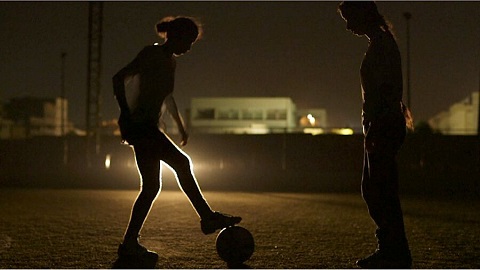
Libya has had a women's football team for a few years now, but even under the Colonel Gadaffi era, it was little promoted, so when he was ousted and executed the hope was that there would be a new dawn of optimism for the nation, where new freedoms could be embraced and new equalities too. Certainly the female footballers felt that way, and were keen to train for matches they had set their sights on at an international level, only to find that unlike the men's team, the most exposure the women received was to be denounced in mosques and on television as expressions of decadence to be blamed on the West, and the start of a slippery slope towards utter moral corruption...
All for wanting to play a game of football on a regular basis. British Libyan director Naziha Arebi expected her soccer documentary to focus on the game itself as she followed the team around to their matches, yet she quickly found out it was not going to be that simple, especially when the prejudice against women by the ruling men was so endemic that so much as considering women play sport was an outrage for millions of the male half of the population. Therefore she was reduced to traipsing after her subjects with her camera as over and over they suffered setbacks, and the matter of their sport was belittled and sneered at by a country that had descended into a civil war.
That saw no real end in sight. Who cared about Libyan women's football when the lives of the region were in dire danger, was the question the players were supposed to ask? However, what Arebi discovered was extremely relevant, even though the documentary would not be widely viewed, in Libya or anywhere else: emancipating women, respecting them and increasing their opportunities can be very healthy indeed for a society. Don't listen to the bigots, Freedom Fields not so quietly says, listen to the ladies who have positive ideas of how to improve Libya and lift it out of its internal strife. Nevertheless, when you are getting death threats for playing football with bare legs, it can be difficult to sustain your sense of perspective.
And it should be noted, those players who wish to can play with legs covered, and heads too, if preferred, so where does that leave the imams' accusation that this sport will lead to public nudity from women should they decide to take up athletics or swimming? Looking pretty daft, notably from the viewpoint of the team. Sportswomen in the Arab world seem to receive a rough deal, and it was only a couple of years later that Tunisian tennis player Ons Jabeur (also a keen footballer and follower of the sport) was making history by proving Arabic women could compete at excellent, international level, something the footballers here sadly do not get a chance to do. It's a cliche that it's the taking part that counts, but in this story that's wholly true.
This is down to the ladies suffering so many setbacks that they barely get to play at all, and are delighted when they do, despite not winning anything thanks to their lack of training time, not to mention sympathetic and capable coaching. This meant that Arebi was forced to fill up her film with scenes of her subjects, who are only allowed to go by first names, presumably for safety reasons, at home or at what passes for home as what should be a beautiful country goes to wrack and ruin under the bombs and bullets of the war. All lament that aside from marriage, they are not expected to do anything else with their lives, which makes it cheering when we see some manage to study, and at the conclusion when they are royally fed up, strike out on their own to establish better circumstances for women by educating local girls. It was a chaotic watch, and not always clear what was happening, but you got the idea by and by. Music by Katya Mihailova.