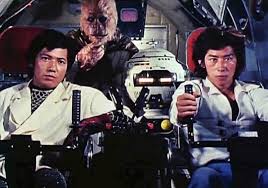
In the fifteenth solar system intergalactic disco teen Hayato Gen (Hiroyuki Sanada) returns to his home planet Analis accompanied by co-pilot and bland Han Solo wannabe Ryu (Akira Oda) and cape-swishing, cigar chomping space ape Baru (Ryo Nishida in monkey makeup, talking apes being all the rage in Japan in the Seventies: e.g. Time of the Apes (1975) and Spectreman (1971). Unfortunately he arrives just after invaders from the evil Gavanas Empire slaughter his entire family. A vengeful Hayato flies off in pursuit of the bad guys, plunging headlong into interstellar adventure while likely giving lead actor Hiroyuki Sanada an instant flash of déjà-vu.
Why? Because Swords of the Space Ark, also known as Space Ninja: Swords of the Space Ark, is a feature film stitched together from episodes of Message from Space: Galactic Battle, the Japanese television show spun off from Kinji Fukasaku's hit Star Wars (1977) cash-in Message from Space (1978). Sanada scored lead roles in both Toei studios' blockbuster movie and TV spin-off released in the same month (July) and same year! Less a sequel than sort of an alternate timeline, the show recycles motifs from the Fukasaku movie that were admittedly second hand to begin with. Star Hiroyuki Sanada essays a different hero to the one he played in the movie. However confusingly chief villain Rockseia, shares a name and costume in common with his cinematic counterpart. Additionally the movie's iconic space galleon, designed by legendary manga artist Shotaro Ishinomori, plays a prominent role in the show but is flown someone other than the movie’s heroine Princess Emeralida.
To its credit, Swords of the Space Ark maintains an undeniable energy and pace throughout a plot that, given its television origin, is inevitably episodic. It is also pretty juvenile, amping up the mystical elements already present in Message from Space to say nothing of its main inspiration: Star Wars. Chiefly via the inclusion of Sofia (Yoko Akitani), an all powerful blonde cosmic fairy who not only gifts Hayato with a super-cool transforming battle cruiser but also serves as a handy deus ex machina, bailing him out of a jam whenever things get rough. And frankly sapping what tension the paper thin plot has. On a visual level at least the miniature effects, pyrotechnics, optical and costumes are of a typically high standard for a Toei production. Much as Star Wars draws upon westerns, fairy tales and the samurai epics of Akira Kurosawa, this lifts heavily from vintage chambara and ninja films. Something especially apparent in the costumes and weaponry though also echoed in the feudalistic plot. Of course Toei were no strangers to giving old historical adventure scenarios a little sci-fi sheen, be it their sentai ('superhero') serial Henshin Ninja Arashi (1972), giant super-robot anime Grandizer (1975) or even Japanese Spiderman (1978) which arguably owes more to pulp ninja fiction than Marvel comics.
Today the show is known foremost for launching Hiroyuki Sanada to superstardom. Very much the equivalent of Tom Cruise throughout Asia, Sanada went on to headline a string of seminal films not only in Japan but also Hong Kong and even join the Royal Shakespeare Company, acting opposite Nigel Hawthorne in King Lear. More recently he has become a familiar face in some high-profile Hollywood blockbusters (e.g. The Last Samurai (2003) starring opposite Cruise, The Wolverine (2013), Avengers: Endgame (2019) and Army of the Dead (2021)) and notable cult TV shows like Lost, Extant and Westworld. While it is strange to see the normally brooding and intense Sanada quite so callow and goofy here, his charisma and screen presence are undeniable. Outside of its impact on Sanada's career, Message from Space: Galactic Battle also became a substantial cult hit under yet another alternate title: San Ku Kai in France where its disco theme song remains an enduring favourite. By comparison the show's feature-length incarnation in America won fewer fans outside of the handful that caught its sporadic airings on, of all things, the Christian Broadcasting Network.