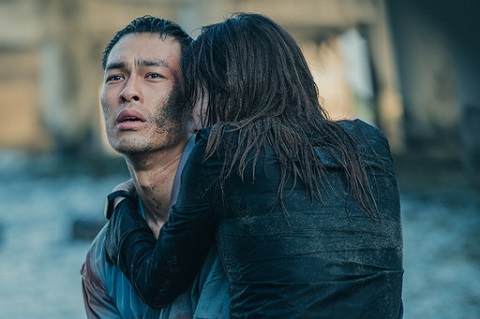
Taiwan is buzzing with news of a serial killer who chooses his child victims by the fact of their disabilities or facial defects, and the police seem no nearer to catching them this far into the killer's spree now than they were when they identified the first victim. But there may be a breakthrough coming when some key suspects are assembled and driven towards an interrogation, or at least that is the idea, for on the bus journey there the wary collection of possible villains are involved in a huge crash, which puts yet another spanner in the works of the investigation. However, they are able to salvage something from the apparent accident, and find a method of assembling the suspects that will not tax the hospitals. But one man is going to suffer for this...
The reason for that is not apparent from the opening ten minutes or so, but soon becomes plain when we have someone in a lab coat to explain the plot for us, as in a nineteen-fifties science fiction flick. But things had moved on since then, right? Yes, now we had serial killer fiction to occupy us, a global obsession that depicted the murderers as genius manipulators rather than sad bastards with serious issues, so what was on offer here with Plurality (a bit difficult to pronounce for a movie title, no?) was yet another intense cops vs puppetmaster criminal yarn only with a lady scientist thrown into the mix for exposition and, after a while, the action too. Yes, it was in the action genre as well, more so than M. Night Shyamalan's Split, which was claimed to be the chief influence.
While there was an element of truth in that, you could also discern a mishmash of anything from Se7en to Source Code, as writer and director Aozaru Shiao was wont to pick and choose where he was getting his inspiration from that would be a treat for those who like to identify what bit of a derivative movie is lifted from where. The fact that he was willing to dive right into bad taste and serve up a serial killer of already disadvantaged little children said a lot about the rather oblivious nature of the storytelling here, maybe that was less commented upon in Taiwan, where this hailed from, but elsewhere it did seem needlessly cruel as a way of upping the stakes, especially when at the point we catch up with the characters many kids have died already. However, it did explain the extreme lengths the cops go to in order to secure their information.
Here was the science fiction: a prisoner (Tony Yo-ning Yang) has been implanted with the personalities of all the suspects on the crashed bus, all the better for the cops to interrogate them, though the mechanics of this were not really explored, and just as well because stuffing almost ten personalities into the same brain is not something that sounds like a good idea, more of a mind soup. Anyway, the lead detective (Frederick Lee) is satisfied enough to keep up the study despite the information he needs not exactly being promptly forthcoming, all the personalities being pretty cagey which would make most people think the process was next to useless. But the lady scientist (Sandrine Pinna) is adamant they must pursue this, not least because she has had a son kidnapped by the killer and needs to know how to get him back before it is too late. Plurality really should have been a mess of wacky amusements, yet while it keeps you watching, if only to see how it will resolve its bowl of noodles of a plot, it was far too dour to be enthusiastically embraced, ironically or otherwise. For a ridiculous premise, it wasn't half taken seriously.
[Signature Entertainment presents Plurality on Digital Platforms from 19th July 2021.]