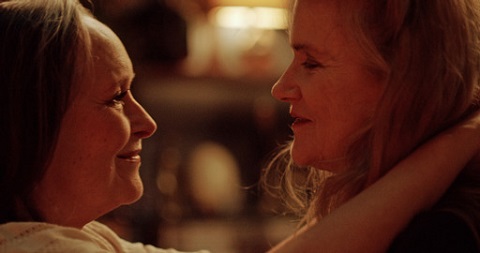
Nina (Barbara Sukowa) and Madeleine (Martine Chevalier) are neighbours in a Paris apartment building, living across the hall from one another. But there is a reason they chose their homes, so close by, and that is for the past few decades they have been lovers, Madeleine invited into Nina's arms after a marriage that produced two children, now grown, and a lot of abuse from her husband. But now she is finally happy with Nina, and they spend as much time together as possible, sharing their lives largely in secret as to the true nature of their affection, though Nina wishes her partner could be more open about it, especially to her children...
If you did not know going in that there was trouble ahead, you would be able to guess it from the snippet of nightmare that began the film, two little girls playing hide and seek until one of them vanishes for good around a tree, leaving her friend to call for her, only her calls emerge like the caws of a crow. We are privy to what seem to be Nina's nightmares a couple more times in the earlier stages, which add the tenor of a chiller, something intended to be disturbing, to what you might have believed was a heartwarming tale of late in life love, yet as it plays out you realise that something is looming over them that looms over each and every one of us.
However, that will bring complications that a hetero couple would not have to worry about and this gay couple do. Some of us like to think the gay people in our society are more accepted than ever, and while that may be true, it is certainly not universally the case, and it is not the case for poor Nina and Madeleine. The former is frustrated that the latter will not simply step out of the closet and enjoy her secret identity by coming away with her to Italy where she feels they can be themselves and happily live out their retirement in peace, away from the cares of the world. But those cares have a habit of making their presence felt with a worrying insistence.
So was Madeleine correct that they have to exist like this? Why is it anyone else's business anyway? Alas, it does seem to be precisely that when a twist occurs that may see them kept apart for the rest of their time on this Earth, which is unthinkable to them both, but especially Nina, who even goes to the extent of criminality to get her way and stay by her lover's side, risking losing the sympathies of the audience. That she ultimately does not, for most of us at least, was a testament to Sukowa's skill with keeping us invested in this couple and her increasingly desperate, some would say verging on the unhinged, manner Nina goes about holding on to the only person who mattered to her in this world: you utterly understand why she would not want to let go.
In fact, you utterly understand why she can never let go, and imagine if the Grim Reaper came a-knocking he would have been frogmarched to the exit by Nina before so much as a swish of his scythe. The analogy is apt, because over and over director Filippo Meneghetti employed the language of thrillers and horrors to relate his story, keeping us on edge as the panic threatens to rise in the couple's minds and engulf them. The intolerance they face is not the only problem they suffer, but it sure does not help, and the messages of old romantic movies do not necessarily hold true here, love may not find a way. That we leave the couple on a note of uncertainty indicates the film's purpose is to unsettle, or perhaps to make us more aware of what we should value in life as it may be taken away without warning. Undoubtedly it tells us not to end a conversation on an argument, because one of those conversations will be the last. Music by Michele Menini.
Aka: Deux
[Two of Us - in UK cinemas and digital 16th July 2021.]