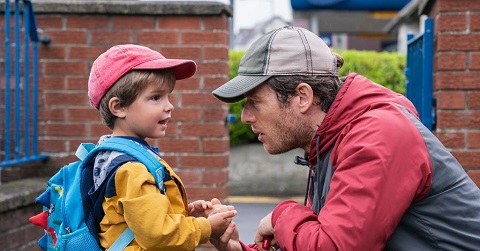
John (James Norton) is a Northern Irish window cleaner whose partner left him mere months after giving birth to their son, Michael (Daniel Lamont), so he has had to bring up the child on his own. Or at least, that was the idea, but now John has been diagnosed with terminal cancer and will not be around to see his boy grow up, and he is deeply worried about how his son will cope, as he is at nursery school age and may not understand why his daddy has to leave him forever. He tries to keep life as normal as possible, but that is growing ever more difficult, and the matter of who will adopt Michael is becoming more and more pressing...
You imagine, from reading that introduction, if you feel the tears welling up in your eyes without even seeing the film then you will probably be in floods from the first minute if you do decide to give it a try, as while it was understated for the most part, it could not resist being sentimental on a basic level, with the mention it was based on a true story guaranteed to make the audience feel even sadder knowing it happened after a fashion in real life. Indeed, it was akin to a nineteen-fifties Hollywood weepie, the sort of thing Margaret Sullavan might have appeared in, in the way it somewhat ruthlessly aimed for the tear ducts, except Margaret would never have played a window cleaner.
Northern Irish or otherwise. Norton had a tricky job here, as we can see that John wants to hug the little boy until it's past the point of no return and he has to go, but that would alert Michael that something was badly wrong, so he has to sustain the air of normality, no grand gestures whatsoever. As the title says, he doesn't take the kid to Disneyland or anything, couldn't if he was able, anyway, so they just go nowhere special, keep it low key so as not to upset the child as all the while his father's life is falling down around his ears. The director was Uberto Pasolini, best known as a producer (The Full Monty was his biggest hit in that capacity), and you may observe a note of Ken Loach here.
Yet despite the setting, you could also discern a strong note of Italian neo-realism in this, making the drama as authentic as possible but in that classic style, not being afraid to elicit the big emotions, in the audience if not the characters as a signature shot will be of the cast holding back the tears but nobody actually breaks down, especially not when Michael is present. The narrative took the form of John visiting a succession of potential foster parents as he becomes obsessed with finding the right home for the boy, painfully aware that if he makes the wrong decision in who looks after him it could mess up his life worse than his father dying when he is small. They visit some good people, but there's always an issue that stops John from committing fully to handing the kid over to them with a clear conscience.
That said, it is rather obvious which one he will choose, as while the others are grounded in a kind of reality, some are more harassed than others, one couple is plain weird (in a tragic way), and another makes the mistake of dissing dogs when Michael has expressed the wish to own a puppy. The cynical may not appreciate being manipulated so blatantly here, but you cannot say you were not warned, and the determinedly mundane circumstances contrast with the crushed feelings everyone is trying and failing to avoid, so there is a truth to what we see, aside from the odd misstep (John's revenge on a nasty customer comes across as out of character, for example). But at the heart of it was coming to terms with death, its inevitability, and its unfairness when singling out who goes and when, as John is only in his mid-thirties, not to mention the effect on Michael who we suspect knows more about what is going on than he is given credit for. Basically, if you wanted a good cry, this was shameless in allowing you that indulgence and there was a sweet note of hope struck at the close - life goes on. Sad guitar and piano music by Andrew Simon McAllister.
[Nowhere Special - In Cinemas from 16th July 2021.]