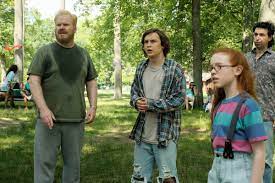
Fed up with authoritarian father Frank (Jim Gaffigan) trying to control his every move, rebellious seventeen year old Philip (Logan Miller) grabs the chance to sneak off to another town for some spring break fun. Whilst attempting to flirt with girls by the pool Philip is shocked when he sees Frank stroll by. He is even more alarmed to see his father casually embrace Kelly (Isabelle Phillips), a cute teenage girl working at the resort. When Philip follows them home he discovers Kelly is Frank's daughter. Turns out his father has a secret second family including free-spirited artist wife Bonnie (Samantha Mathis) and son Eddie (Gage Banister), a superstar athlete. Yet rather than inform his mother Laura (Anna Gunn) and kid sister Lib (Emerson Tate Alexander), Philip decides to use this information to his advantage.
A slight but amiable indie comedy Being Frank makes canny use of the unique screen persona that allows comedian Jim Gaffigan to portray both affably exasperated family men and slightly creepy dudes. Set in 1992, for no obvious reason beyond soundtrack potential and lack of social media lending credence to Frank's ability to pull off this ruse, Glen Lakin's script boasts an intricate, well conceived and compelling comic premise. Yet the film still hobbles its own potential. As portrayed by Logan Miller, a specialist in smarmy youths (see Scouts Guide to the Zombie Apocalypse (2015), Love, Simon (2018), We Summon the Darkness (2019)), the film instantly establishes Philip as someone who openly challenges Frank's moral authority. This saps a lot of power from the sudden shift in their dynamic.
Initially the pain Philip feels upon realizing he spent his whole life unwittingly in the shadow of half-siblings that are respectively smarter, more physically capable and simply cooler than him, seems to indicate Being Frank is headed down a more moving, nuanced path. However once Philip inveigles his way into Frank's second family the film seems as unsure as he is about the next step. While Frank assumes his son wants to blackmail him, Philip seems more resentful his family were denied the more carefree, fun side of his father. While the film does not entirely succeed at making us empathize with Philip, gradually cracks do start to show in his surly facade. He comes to realize not only does Eddie also bear the brunt of his dad's expectations but that Frank himself is as insecure and yearning for freedom as Philip is.
Indeed Frank, for all his undoubted flaws and transgressions, emerges a complex, semi-sympathetic character. At the same time though the film cleverly has Frank grow overly keen on showing off his ability to deceive. Thus revealing to Philip and the audience that while not a monster, Frank is still selfish. Gaffigan delivers the standout performance. He plays befuddled panic quite brilliantly. Making her feature directing debut, actress and prolific producer Miranda Bailey mines genuine laughs from awkward moments including a potentially icky but actually well played subplot detailing Kelly's infatuation with the boy she has no idea is her brother. By comparison a secondary subplot dealing with Philip’s buddy Lewis' (Daniel Rashid) struggle with his sexuality seems to have strayed from an altogether different movie. Meanwhile a tertiary subplot with lovely former Disney Channel star Danielle Campbell as Philip's lust object is even more superfluous.