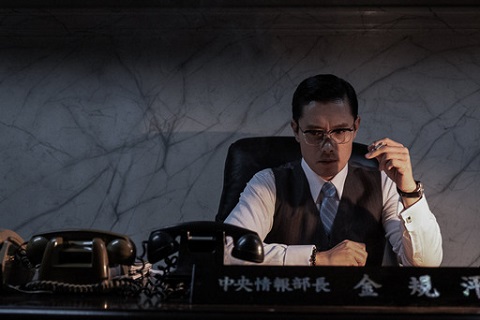
In 1976 in South Korea, President Park (Lee Sung-min) was assassinated, sending shockwaves through the nation and leaving its denizens deeply divided over whether this had been a necessary overthrow of an increasingly deranged dictator, or the unreasonable murder of the father of their modern society. This will play out as the story of the forty days leading up to the killing, in October, as the head of the Korean Central Intelligence Agency, Kim Kyu-pyeong (Lee Byung-hun) finds himself at odds with both his turncoat predecessor in the role, and the President, a former, close ally...
Director Kim was a real man, but in this telling, it was significant the movie had changed his actual name for the purposes of this fictionalisation, making an espionage thriller out of some still-murky politics. This was a curious choice, since Koreans watching would be well aware of the character's real name, while foreigners would be none the wiser - was there a legal issue with this act of conjecture, perhaps? There was plenty of invention around what happened behind closed doors, and while it was pretty slick as a big screen conspiracy drama, for the facts those interested may feel frustrated.
The film director (as opposed to the Agency director) was Woo Min-ho, and his careful recreation of the mid-nineteen-seventies was rewarded with this being put forward as South Korea's Oscar contender; though it was not nominated, maybe thanks to it not being as thematically or stylishly audacious as Parasite the previous year, the country's cinema was being respected as never before. Thus The Man Standing Next, as well as being appropriately patriotic in its concerns, retained some well-reviewed kudos as something worth regarding on that international scale, despite its subject matter not exactly enjoying universal interest due to its historical (and geographical) specifics.
If anything, it resembled a Costa-Gavras conspiracy effort from the seventies rather than the paranoid works Hollywood had been churning out in that decade, though both approaches had influenced movies well into the following century. The difference here was that we were following the main movers at the top of the tree rather than the protestors or political prisoners who were their victims, though the former KCIA director fits that bill, and has his own action sequence as he attempts to escape capture after his memoirs are sensationally published against the wishes of Park. Kim is deliberately harder to read, so to speak, and Lee played him as a man constipated with emotional repression.
Again, not the easiest of entry points into a factual account, and in this fictionalised one there was a threat of non-Korean audiences zoning out through the long build up to the events that have been telegraphed in the film's introduction, thereby undercutting much of the suspense for those who did not know the story (or what could be discerned from this secretive lot). Fortunately, even as Lee dialled it down, his movie star magnetism was present no matter that we were often uncertain what was going on in his character's head, and he was supported by a cast who added a dash of personality to what was a little dry in places. Interestingly, this did not really allow you to forget that this was a version of circumstances that may not have transpired in this specific manner, allowing that the assassination was the source of much controversy and not about to make Kim too much of a hero, though not necessarily an out and out villain either. Whether that was helpful was a moot point: it simply kept the story alive. Sinister music by Jo Yeong-wook.
[Blue Finch Film Releasing presents The Man Standing Next in Virtual Cinemas including Curzon Home Cinema 25 June and on Digital Download 5 July 2021.]