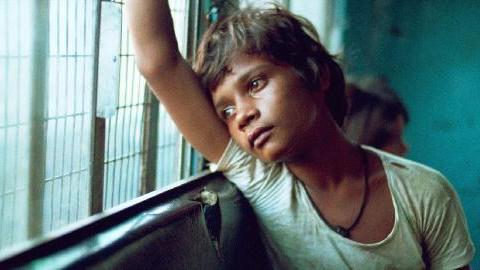
Krishna (Shafiq Syed) is an eleven-year-old boy from rural India who was forced to leave home by his family to make money for them by joining a travelling circus, and he believes that if he can only raise five hundred rupees then he will be welcomed back with open arms. Whether this is the case is another matter, and he will have a mountain to climb when he is sent on an errand by his boss, yet on returning to the site where the circus had been, he finds they have packed up and left without him. This leaves him in trouble, but as he has a little cash on him, he is able to buy a ticket to the nearest big city, in this case Bombay.
If you regard certain dramas by Satyajit Ray to paint a sentimental portrait of poverty in India, and wish for tougher fare, then director Mira Nair was on hand with this Oscar-nominated piece to really make you feel every insult to the dignity of existence we are supposed to appreciate, assuming we are lucky enough. About as far from a sunny Bollywood romance as it was possible to get while still being shot in the same city as those local blockbusters, this proved an arthouse hit with Western audiences in the same way something like Brazil's Pixote had enjoyed a few years before, rubbing the audience's willing noses in the misery.
Indeed, Nair makes Bombay, or Mumbai as it went on to be called, look like Hell on Earth, if you do not have the money to make life better for yourself at least, and little Krishna certainly does not. Naturally, a lot of Indian moviegoers rejected the film, not because it was badly made, but because to them it appeared to have been made for foreign eyes in the vein of what would soon be termed misery porn, allowing those Westerners a chance to cry into their popcorn for a couple of hours then return to their comfortable beds at night without considering the likes of the street children we saw here any further; that was the general belief, anyway.
It is worth pointing out, however, that Nair did channel the profits into a charity that helped tens of thousands of Indian street kids have better lives, so the act of buying a ticket - or buying a disc, or renting it online - was going to do more good for the victims it depicted than ignoring or dismissing the project as pandering to non-Indian sensibilities. Knowing this would make you feel better for watching Salaam Bombay! as it pulled no punches, and from some angles might have appeared as if Nair was trying to send the audience on a guilt trip rather than telling a vital story. However, she did ensure that every character here, or every one with more than a scene or two, was as three dimensional as she possibly could, for that all-important authenticity.
Of the cast, some of them were professional actors but many more were not, picked up off the streets to be trained to perform and in effect rescue them from their acute disadvantage, and it was cheering to be aware Syed managed to escape from his homelessness as he grew up and started his own business, though the acting bug did not drive him on to fresh thespian challenges as it transpired. This film touched on a variety of topics, from prostitution (Krishna ends up as a teaboy in a red light district) to forced marriages to drug abuse to bullying and even female genital mutilation, albeit in passing, so much so that you might begin to ponder Nair had too much on her plate to do justice to it all. Yet she was accomplished enough to have you consider this multifaceted state of poverty, and if the cityscape was one suffering rampant exploitation, then it would provoke interest in many about doing something positive to end that, even if it was simply supporting this movie to help. Music by L. Subramaniam.
[The BFI release this on Blu-ray with these features:
Indian Cabaret (1985, 60 mins): Mira Nair's documentary about female strippers from a Bombay nightclub which provided the kernel of Salaam Bombay!
Audio commentary by Mira Nair (2003)
Sandi and Bernard Sissel in Conversation (2021, 51 mins): newly recorded discussion with the cinematographer and her son, one of the street kids from Salaam Bombay!
Archive shorts (1906-1936), 31 mins): three gems from the BFI National Archive reflecting themes and iconography found in Salaam Bombay!, featuring city life in La vie aux Indes / Indian Scenes, an early Dickens adaptation of Oliver Twist and a look at tea production in India and Sri Lanka in Gardens of the Orient
Original theatrical trailer
**FIRST PRESSING ONLY** Booklet featuring a new contribution from director Mira Nair, new writing on the film by Manish Mathur and a biography of the director by Ellen Cheshire.]