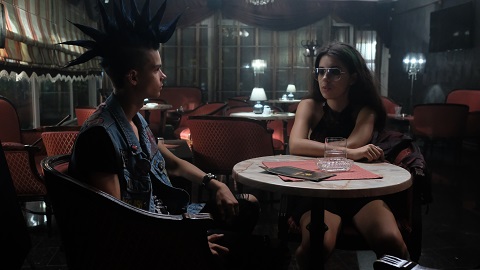
The place is a Hungarian city, the time is the evening and darkness has fallen, and in this restaurant a woman sits with a teenage girl deep in conversation. The woman wishes to know why the girl has a compulsive need to lie, because it is causing real problems at work and at college, but the teen simply apologises and responds with more lies. Meanwhile, not so far away another woman is in a florist's with her daughter when she finds the assistant's tone offensive, so offensive that they end up in a screaming match with each other after she smashes a plant pot.
And so it goes on, across the city, relationships on a knife edge and nothing to pour oil on troubled waters... Treasure City was indeed a Hungarian film, from writer and director Szabolcs Hajdu who had spent the previous decade or so forging a career as an auteur, in between acting jobs (he also took a role in this). This would be his highest profile release to date, and though it was not exactly packing out the world's multiplexes there was a degree of interest in it that he managed to drum up, with a lot of focus on the ending which drifted into magical realism, seemingly from out of the blue.
Before that, there were oh so many arguments, passive aggressive exchanges, and simple abuses of power and discomforting reactions to apparently mundane social situations, so much so that you would think twice about booking a Hungarian holiday after seeing this. It was well-acted, certainly, but it was also difficult to pick out many characters who were particularly likeable since we often saw them at their worst and were rarely offered them at their best to contrast that with. Structurally, it resembled a cross between Robert Altman's Short Cuts (at half the running time) and a Roy Andersson sketchlike movie, though if you were feeling less charitable you could describe it as a Hungarian variation on Oscar-winner Crash (the racism drama, not the David Cronenberg car strangeness).
There was even a thread throughout that examined the director's countrymen and women's reaction to the migrant issue afflicting Europe, as we heard occasional bulletins about shocking events and a protest was held to criticise the former Communist authorities for carrying on as usual. Also, some characters were accused of being immigrants, and not in a good way, but precisely what this was trying to tell us was something of a mystery unless you were up on the details of Hungarian politics. Fortunately, there were scenes that did not rely on that kind of information, you merely had to watch the sparks fly as various individuals butted heads or exploited their fellow citizens, many as if such immorality was second nature to them, because, one supposed, society drove them to it.
Though once again there were matters that we did not appear to be getting all the background to - and those times being a local would not help you in understanding or perceiving - why these folks behaved as they did. Obviously, anyone is subject to a number of whims throughout the day (or night), but this lot were purely perverse in bolstering their shaky senses of self with a selection of sniping, battling and disputing, to the extent you found yourself sitting back passively as their activities ranged from eccentric to downright abusive: more than once a man will strike a woman out of sheer frustration, though nobody here seemed to deserve having violence visited upon their person. It said something that a calmer moment developed into an arm-wrestling match with a stranger on a train, and a more disturbing moment went all Harvey Weinstein for a young actress. But this was so offbeat that it contrived to stick with you, precisely because it was troubling, not because it felt hugely authentic - it was reaching for something about human nature, and you kind of got it. Music by Freakin' Disco.
Aka: Bekeido
[ACCLAIMED HUNGARIAN DRAMA RELEASED IN UK, in Virtual Cinemas and Premium VOD 18th June 2021.]