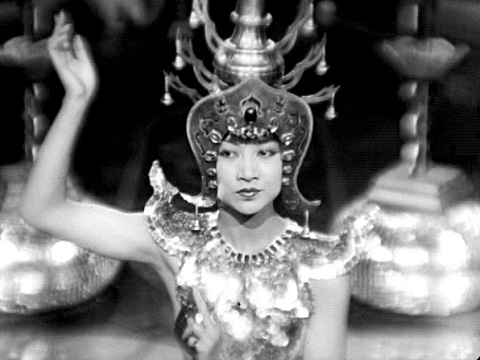
The big draw at the Piccadilly Club is the dancing duo of Mabel (Gilda Gray) and Victor (Cyril Ritchard), who take to the ballroom floor for a display of hoofing the likes of which London in the Roaring Twenties has never seen. But what the public do not know is the couple's working relationship is not as sunny as it appears, indeed Victor is in love with Mabel, but she brushes him off and prefers the club owner Valentine Wilmot (Jameson Thomas) who she is partly in love with, and partly looking to boost her career by association with him. Yet she has reckoned without Shosho (Anna May Wong) in the scullery...
Anna May Wong was the first Chinese American to become a movie star across the world, and as such has attracted a fascination ever since, as much for the chances she missed due to racism as for the opportunities she did enjoy. She could not be a "conventional" leading lady in Hollywood, that was, a white star, since the Code of production forbade her enjoying romantic scenes with any actor except a similarly Chinese one; they would call it miscegenation if she did, and that was as good as illegal and would have ruined her career. At least in Piccadilly she was allowed to be romanced by a white man, but even so there were caveats.
She was not allowed to kiss him, for instance, and since she and the Wilmot character were obviously having a terrific time together, the morals of the day decreed their affair should end tragically. Therefore audiences were given the thrill of a woman of Asian descent who was obviously beautiful and prompted to imagine what it would be like to fall in love with her, then asked to enjoy her punishment for stoking such ardour. At least director E.A. Dupont included a scene where a random white woman is thrown out of a pub for dancing with a black man, thereby acknowledging the prejudices of the times were suffered by many.
Before it all went pear-shaped for Shosho and Wilmot, he has placed her as the jewel in the crown of his nightclub show, though interestingly on her own terms: she knows what is best for her and refuses to compromise. Though it was sweet to see her delight at getting good reviews in the newspaper for her dance act: she was not quite the dragon lady stereotype she could have been and what Wong was trying to escape from by seeking work outside of the restrictive Hollywood establishment. Nevertheless, those more bigoted views against the Chinese that had been exacerbated since Victorian times were not entirely absent, and this would have been a more satisfying experience with a happy ending.
Actually, none of the three leads had happy endings in real life, all dying prematurely in their fifties. Thomas probably had the best of it, moving to Hollywood and playing a few cads before succumbing to tuberculosis, while Gray was a Polish American cabaret dancer credited with inventing the shimmy (which she does here!). She dearly wished to be a movie star, and this was her best shot, only to find herself outshone by the allure of Anna May Wong. As for Anna May, she suffered a troubled personal life with a string of affairs and a tendency towards alcoholism as a result. As one of the earliest, true cult movie stars her fans to this day will tell you she deserved better, and it's impossible to disagree, as all the acclaim in the world was not much use to her after she died. But you can see her at her best here, acting everyone else off the screen, and making you wonder what she could have achieved in more enlightened times. Look out also in Piccadilly for Charles Laughton as a revolting diner!
[The BFI release this on Blu-ray with the following features:
Remastered by the BFI National Archive and presented in High Definition
Talk of the Town (2021): an in-depth interview with film critic, author and filmmaker Jasper Sharp on the life and career of Anna May Wong
Piccadilly: A Video Essay (2021): a newly recorded video essay by BFI curator and silent film expert Bryony Dixon
Cosmopolitan London (1924, 10 mins)
Neil Brand on composing for Piccadilly (2004, 20 mins): the acclaimed composer discusses his score for the film
Prologue from the sound version of the film (5 mins)
Newly commissioned sleeve art by David Downton
**FIRST PRESSING ONLY** Fully illustrated booklet with new writing on the film by BFI curator Bryony Dixon and an essay on the score by Neil Brand.]