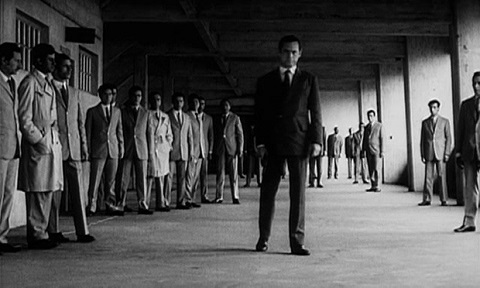
The city of Aquileia is about to be under siege from the enemy forces encroaching on the land. A port in South America, it already has in its ranks a number of middle-aged men (and one woman) who are willing to rub their hands together and get on with combatting the repressive menace, even as they are hunted down one by one by this antagonist. They are led by an older man who must be protected at all costs, for he is their chief strategist and has the best ideas about how to repel the invaders. But they will find their resistance met with an equal and opposite resistance...
This was almost a lost film until a print was found and restored in 2004, long after the pressing matters of a military dictatorship had supposedly abated from the Argentine political landscape, and democracy had returned. But as with much South American cinema, totalitarian regimes were very much on the minds of its creative talents, and that was true of the director here, Hugo Santiago, a man who is not widely known outside of specialist filmic interests, and co-writer Jose Luis Borges, a man who definitely was widely known, particularly during his own lifetime, as one of the world's literary giants.
That latter input into Invasión was the main reason it was sought out and revived at the start of the twenty-first century, and fans of the author would be pleased that it was more or less of a piece with his writings, if more prone to cinematic genre referencing as befitted the deliberate sense of purpose in the otherwise loosely defined characters. If there was a science fiction film it resembled, that would be Jean-Luc Godard's Alphaville, since it rejected special effects and used whatever was to hand on the locations to craft its sense of paranoia and threat of a future at the mercy of sinister forces - not a bad prediction.
For much of its continent, anyway, and Argentina more specifically, as you could not divorce the purposefully "one size fits all" conspiracy thriller incidents from the context of its parent nation's increasing threats to freedom of thought. That said, we were never entirely clear if we were following the goodies or the baddies here, as both sides implemented similar tactics against the other to gain the upper hand so that it is only at the conclusion where we have seen which won that we can be sure who was representing the incoming oppressors. Before that, the story, such as it was, toyed with political statements that remained weirdly non-specific, and the tropes of the genres it preferred, decked out in vintage B-movie black and white.
Therefore you were served up weapons smuggling, espionage, secret meetings, gunfights in abandoned buildings, and so on, all of which could have been corralled into a narrative far more conventional than the way this resulted, but this try at being allusive to make the creators' concerns as obvious as possible did make this curiously compulsive viewing. You may not be privy to all the information as to what was happening, but this emulated the style of a mystery suspenser so you would be drawn in and react in the same manner as you would to a similar movie out of Hollywood or Western Europe, it was just that there was seemingly more at stake thanks to a curious authenticity to what could have been a bunch of adults playing cowboys and Indians, in effect. There was even a scene where one character escaped into a cinema showing precisely that, as if winking to the audience on a meta level. Don't expect to have any more idea at the end than at the start as to what was really going on, and you may be pleasantly surprised.