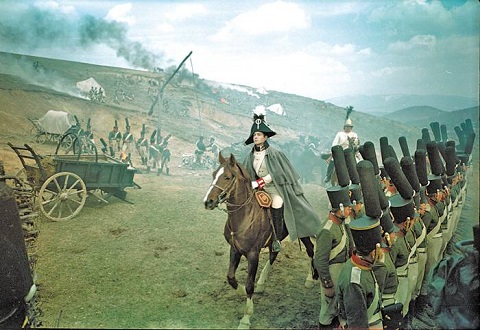
It is the early nineteenth century in Russia, and the populace cannot ignore the events in the rest of Europe as Napoleon masses his troops and has already invaded and conquered most of the continent. There are rumours he is heading east with the Russian homeland as his target, and a patriotic fervour is being whipped up among the men of the country in preparation for its defence. But for aristocrat Pierre Bezukhov (Sergey Bondarchuk), an intellectual but ineffectual with it, he wonders what worth there is in war, while his friend Andrei Bolkonsky (Vyacheslav Tikhonov), a Prince, feels this approaching conflagration is destiny calling to him...
The Soviet War and Peace was, of course, drawn from the Leo Tolstoy novel that had been a sensation in Russia in its day, and despite the best efforts of the authorities' disdain, remained hugely popular there for its perceived patriotism. However, a film version had not been made since the silent days in Russia, so Hollywood stepped in to take advantage in 1956, crafting one of those historical epics that went over so well in that era and as this was at a time of cultural agreement between the two Cold War nations, it was released in the East too, becoming a big hit. Not, however, because the Russians liked Hollywood's take on their greatest literature.
Nope, like everyone else in the world in the fifties, they were in love with Audrey Hepburn, its star. Nevertheless, to be shown up in this way was not tolerated by Nikita Khrushchev's government, and they set the state filmmaking arm in motion to make the Russian movie to end all Russian movies, a riposte to Hollywood's temerity, and thus, in the late sixties, director and leading man Bondarchuk's War and Peace was released across the globe, earning the Best Foreign Language Picture Oscar in the process, as if the Americans had admitted, okay, you win this round! It's the most expensive movie ever made, after all, we cannot compete with that scale!
Naturally, it was nothing of the kind, as while it had taken a lot of manpower and years to concoct, it had not been as costly as the Soviets pretended. But what did money matter in the face of spectacle? Spectacular was the word for this as Bondarchuk used the techniques of the experimentalists in Soviet cinema which were not popular at home but appealed to the cognoscenti abroad and combined them with a desire to pack the wide screen with as many people as possible to manufacture an experience that on the silver screen in that decade was positively overwhelming, not least because you had to take a meal halfway through to make your way to the end.
But all the visual dazzle in the world was not going to obscure a storyline if it did not appeal to the heart. The central trio of characters, Pierre, Andrei and Natasha Rostova (played by ballerina Lyudmila Saveleva), wove in and out of one another's lives as the war, and indeed the peace, played havoc with their existence. Natasha was the all-important heart of the emotions, starting as a naïve girl whose biggest deal is the society ball, while Pierre was the head and Andre the reason so many were so keen to fight, a combination of the two. They romanced each other, were romanced by others, but always that war was looming even as we could muse that the manner in which they obsessed over the way people thought about them was not so much different from the way people do the same in the twenty-first century.
But while Bondarchuk employed stylings unexpectedly psychedelic in places, ahead of his time, it was the battles where he truly shone, massive stagings that in the CGI era continue to amaze knowing everything you see genuinely took place before the camera. From the 1812 battle to the burning of Moscow, they threw everything but the kitchen sink at this to conjure vision after vision of sheer Hell, and the effect was startling and deeply resonant. You could let the finer details of the plot wash over you (hey, that's what books are for), but the sights parading before your eyes were wildly over the top and somehow never less than appropriate to the enormous undertaking. Besides, it would be difficult not to be stirred by Pierre's transformation from bumbling nerd to the bravest man in the story as he recognises he cannot sit out the march of history on his own doorstep. Music by Vyacheslav Ovchinnokov.