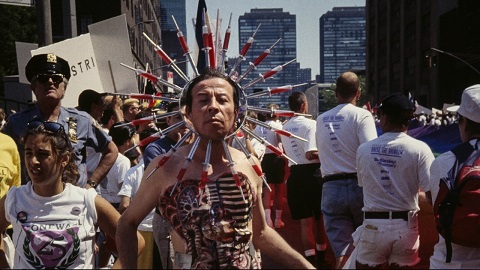
Pedro Lemebel died in 2015, but one of his last wishes was to be the focus of a documentary film, which his good friend Joanna Reposi Garibaldi was only too happy to assist with. But he was not to see the results, as he passed away from throat cancer before the work was completed. Why did he believe he was worthy of the documentary treatment? He was not the only one, for although little known outside of his native Chile for much of his existence, he had been a pioneering leader of the homosexual movement that fought throughout the Pinochet dictatorship to be recognised as equal to the non-homosexual society they were feeling trapped in. And this at a time when they were being murdered in the streets...
That's not hyperbole, homosexuals were literally murdered in the streets throughout Pinochet’s ultra-conservative regime, and there are times to reflect here where you marvel that it's amazing Lemebel survived as long as he did. It was the addiction to smoking that killed him, something preventable rather than his performance art and inflammatory essay writing getting him into trouble with the authorities, and if there was a flaw in this film it was that it preferred to drift towards the personal rather than the political, understandable when Garibaldi had such an emotional connection to her subject, but frustrating when you wanted to know more about how he struck back against his oppressors without managing to get himself executed in the process.
Perhaps it was down to his performances being so idiosyncratic, involving waxing his chest, setting off small fires on his own body, and using his blood to paint with, and to an extent, drag, that he was only going to attract a highly specialist audience, and he was not noticed as much as he would have been had he been one of the straight activists. He tells of the Communists and socialists throwing him out of their meetings and protests for being too queer, leaving him somewhat adrift among his peers who he could have been of great value to, and naturally he was not going to get pally with the fascists and upper classes who ruled the nation. We see clips of him on television post-dictatorship, and he seems to be getting the respect that had previously eluded him, yet there is more with him growing sentimental over old photographs and slides.
That was where the autobiography came in, which did ground the focus by filling in his background as a working class homosexual - he detested the word "gay" which he associated with those far higher up the class system and far too quaint to describe himself, even preferring common insults like "fag" which he reclaimed in a manner not unlike African Americans reclaiming the n-word. What became clear was there was far too much material for Lemebel to be summed up in ninety minutes or so, and though Garibaldi had a damn good try, there was a feeling we had merely scratched the surface of the noble - his standing up for his gender when it could have ended his life decades before - and the not so admirable - his belief that AIDS was a conspiracy theory dreamt up by First World countries that South America should reject. Still, you had a strong impression of his erudition, and what a force of nature he was, that made this an education for the majority who had never heard of him. As he deteriorates before the camera, it's not difficult to be a little sad, despite his successes and breakthroughs, no matter that you did not know of him before watching.