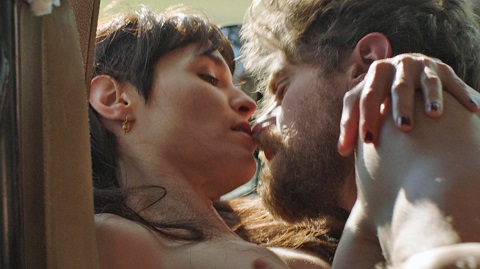
Penelope (Penelope Tsilika) and Dimitris (Dimitris Lalos) carry out what is regarded as an important function in this part of a rundown Southern Europe, as they travel around the countryside and pick up deceased pets from their owners with the promise the bodies will be properly cremated, and the ashes returned to them to do with as they see fit. The couple, who are romantically linked and have sex in the car they use for work, use a spiel to reassure the bereaved as they take away their dead dogs, cats, and even fish and birds, but this repetition does not make them uncaring.
Indeed, Penelope is developing a habit of picking up roadkill from the rural highways, which she's not supposed to do... The above premise makes Kala Azar sound a lot more eventful in promise than it turns out to be, for it was a slow-paced, observational piece that took on a set of memories from its creator's childhood and moved them into the realms of the post-apocalyptic, though perhaps pre-apocalyptic would be a better description, for there is a society here, it's just barely hanging together. Indeed, the only element that is holding it into some kind of pattern is the treatment of animals, or more accurately, pets.
As while we do not see anyone in tears over the loss of their companions, there was a mood of bereavement throughout, if only thanks to the repeated views of dead animals writer and director Janis Rafa had strewn the visuals with. The title came from an insect-borne disease that wiped out a number of the canine population, as Rafa recalled it, when she was a child, and her memories of seeing dead pets and strays in the streets were evidently vivid ones, if not maybe what she should be dwelling on. There was a sense of a spoof without humour here, as often with this Greek "Weird Wave" of cinema it belonged to.
Where people acted irrationally but with perfect understanding for those in the set-up of the plot, such as it was, so you could imagine it as a sketch where pet owners cared more for their animals than they did other people. Except of course, in many cases that was perfectly true, and they would not find anything untoward in this succession of bereft owners indulging in semi-sacred rituals to see off their deceased furry and feathered friends. Rafa was an artist in her day job, operating with video installations and stark tableau that you could see was feeding into her conjurings here, though an aspect of the mystical, even of a life beyond this world, was lacking - humour was somewhat alien to it as well.
Until the picture was almost over and we were given a sequence mixing hundreds of chickens and a brass band playing Elgar which was suddenly, surprisingly lighthearted. Not that that lasted, as we are reminded of the chicken's destination once their musical diversion was over, it was that kind of telling you off for laughing that this type of movie was never going to allow to go too far, after all. Meanwhile, Penelope and Dimitris cavort, meet their clients, see Penelope's parents who make strange potions to rub into her feet, and cause the death of one of the strays by running it over, again underlining the love for animals placed above humanity from the couple's reaction. If anything, there was an environmental message of "you don't know what you've got till it's gone" underlying this, mourning in the wake of burgeoning ecological catastrophe. Not fun, but hypnotic as it tapped into something you may not admit to. Music by Gwil Sainsbury.