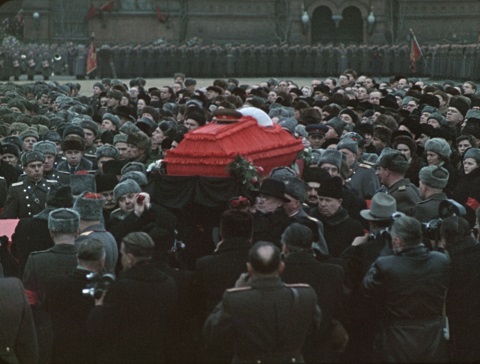
Josef Stalin was the leader of the Soviet Union after the Revolution's head, Vladimir Lenin, died, and led the nation through the Second World War and into the early nineteen-fifties, when he finally died in 1953. There was a lot of footage taken of how the population reacted to this event, but plenty of it was not seen until 2019, when Ukranian director Sergey Loznitsa assembled it into this documentary. In a mixture of colour and black and white, it begins with the announcement of the death over tannoys across the thousands of miles of the Union, as the listeners take in the shock that this "man of steel" could actually die. Yet the presence of cameras has a double intention: to record and to direct.
Loznitsa was probably best known for his accusatory Ukrainian film Donbass, where it took its current Russian interference in his country's affairs to extreme footage, recreated for the camera but based in reality. But he was actually more experienced as a documentarian, and something like State Funeral was more his forte even if he had not captured the footage himself, editing together reels and reels of clips of both the preparation for and eventual staging of Stalin's funeral. This is presented with what might be best described as a poker face, not letting on the opinion of the makers and coldly showing the Soviets of '53 (they do look very cold) as they lined up to see the coffin of their "Great Leader" lying in state.
Knowing what we know now about Stalin's unimaginable massacres of his own people, there cannot help but be a dose of irony to witnessing all this expression of sorrow and respect. The filmmakers described it as an examination of a cult of personality, always a dangerous thing in politics, both for its focus and its followers, and especially those who express any doubts about the leader's big ideas. Nowhere was that more evident than in Stalinism, where millions upon millions were executed, and millions more died of starvation because of the horrendous mismanagement of the nation, all because no one wanted to stand up to Stalin because they were scared, both of the consequences of pointing out his deep flaws, and because they were scared of what would happen once he was gone.
Which is what we see here: the citizens we watch crying could be doing so for the benefit of the camera lens, a put-on to ensure they survive, but equally they could be crying for their own fear of the future, or those they have lost, finally allowed to express grief for their fellow countrymen and women in public. Thousands of them gather in huge squares, or traipse past the coffin giving us a sidelong glance as they notice they are being filmed, not one of them smiling or even so much as acknowledging beyond that suspicious, haunted look they all share. Finally, we reach the funeral itself, with its tedious, glorifying speeches from men wrapped up in big overcoats and hats, vapour escaping from their mouths. And shortly after, they were making moves to dismantle Stalin's legacy to make sure it never happened again, not that soon-to-be Premier Nikita Kruschchev's optimism was well-founded. As a film, it's an oppressive experience that drones on and on, the sheer sinister quality this monolith of mass murder rendered banal by seeing the faces of those who assisted it. But remove the captions from the end, and would it possibly be what Stalin would have wanted?