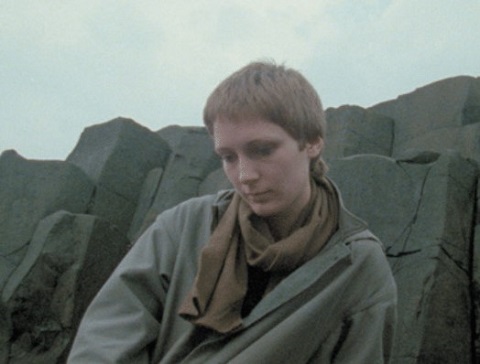
Maeve Sweeney (Mary Jackson) left her homeland some time ago, but maybe it is time to return, if only for a week. She now lives in London, thriving in the arts scene there, but she was originally from Belfast where as part of The Troubles she was a victim of the sectarianism there, especially in her Catholic family - they had to leave their home in a Protestant area, for example. Her father (Mark Mulholland) has seen better days, the conflict has drained him and so many others of life, and her mother (Trudy Kelly) lives in simmering resentment, but maybe there is hope resting with her sister Roisin (Brid Brennan)?
The common complaint many Irish filmmakers had was that too much of the Irish cinema that appeared to portray them on the big screen was made by foreigners, be they Brits or Americans, and the much-derided Wild Mountain Thyme proves that was the case well after Maeve was released. But it could be they had more issues than that, for women's voices were seriously underrepresented, as Pat Murphy was practically the only female director getting material out there at the time of the renaissance in Irish film. Indeed, she only made three films whereas someone like Neil Jordan was awarded an international career.
Not that Murphy and Jordan were really operating in exactly the same concerns, as Murphy was keener to bring a woman's perspective to the politics of her country, thus this, her debut, set out to demonstrate that England's attitude to Ireland was the same as Irishmen's attitude to Irishwomen, in particular during this decade. It was a provocative statement, and she placed it in the mouth of her heroine to illustrate how much of a rebel she was, and how the true rebel was not one who wallowed in the past, but one who looked forward to a better future where Ireland could value women more than potential mothers and housekeepers.
Not that this was a matter exclusive to Ireland, and Murphy worked hard to generate a portrait of a variety of women there, from Maeve, who had to leave to flourish, to Roisin who stayed and is all set to fall into line, tolerating the stern warnings all around to conform as her youthful spark is dimmed by fear and a reluctance to be a mould-breaker. Meanwhile mother Eileen is what Roisin will become if she's not careful, she did everything the men told her and it has twisted her up inside, the point being that The Troubles were a male construct, and any women involved were more often than not casualties of the masculine tendencies towards violence and claiming territories for their own; claiming women, too.
It was a concept that would probably have created more waves had anybody very much paid attention to Murphy's film, but as it was after its initial release and generally polite reception from the few outlets that covered it, its revolutionary leanings as far as the battle of the sexes went were largely ignored. This was somewhat ironic in that Maeve is constantly put in her place by the men in control, and the women who act as their lackeys (nuns, the older generation), so to see it happen to Murphy kind of proved her point. Not that the film was without problems of its own: it made no attempt to sweeten its message with humour or levity, and was near-relentlessly dour, not the kind of thing to attract the masses to the cinema of the eighties when Hollywood was King and tiny films like this were swamped. Even the likes of Cal and Angel had more of the spotlight. Perhaps the question now was, is Maeve still relevant? And it probably was, if you had the patience for it. Music by Robert Boyle and Pete Nu.
[The BFI release this on Blu-ray with these features:
Remastered in 2K by the BFI
Being a Woman is a Nationality - a Video Essay on Maeve (2021, 14 mins): filmmaker Chris O'Niell explores Maeve's themes of feminism, republicanism and nationality in this new video essay
Irish Cinema - Ourselves Alone? (1996, 51 mins): Why have the most enduring celluloid images of Ireland been made by foreign filmmakers? That's the core of this documentary by Donald Taylor Black - showing the struggles of Irish people to create an Irish cinema. Featuring interviews with major figures including Neil Jordan, Bob Quinn, Jim Sheridan, Pat Murphy and Roddy Doyle
Limited edition with a booklet featuring a new discussion on the film between Pat Murphy, John Davies and Robert Smith and a new essay by Emmie McFadden,]