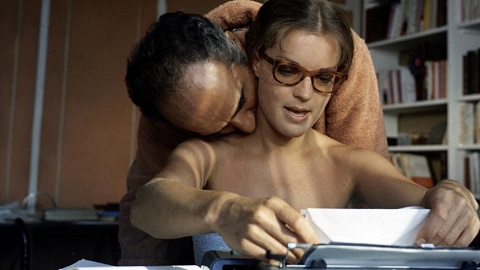
There has been an accident on this country road, at the crossroads, and the police are trying to piece together a description of what happened from the two truck drivers who were involved, but unharmed. There was another man (Michel Piccoli) in a car that hit both the trucks and flew off the road, and he is currently lying in a field next to his burning vehicle, unconscious, so it's no use asking him, they will simply have to wait until the ambulance arrives to transport him to hospital. But as he lies there in the grass, among the poppies, there are thoughts running through his mind, thoughts about his mistress Helene (Romy Schneider) - will he see her again?
A film about the tiny details of existence and how they build to create an entire life of experiences, no matter how apparently trivial, Les Choses de la vie, or The Things of Life as it was rather starkly named was director Claude Sautet deciding this New Wave business was not for him, and he was going to study the bourgeoisie instead. Did Jean-Luc Godard slave over a hot camera for that? Apparently so, as it quickly picked up a following and remains a cult item to this day, largely because of the intricate manner in which it staged and restaged its central car crash. J.G. Ballard would have surely come over all unnecessary at the extent they went to in this.
Not that there was very much out of control carnal about Pierre's life, he loves his mistress but aside from some playfulness and a little obviously morning after the passionate night before waking up in bed together, sex did not take up much of the story. As Pierre, Piccoli was in his element as a French everyman, assuming the everyman happened to have a comfortable bank balance and the choice of two women to return to every night, the other being Catherine, played by Lea Massari, that ambassador of European chic in the nineteen-sixties and seventies - not that Schneider was any slouch in that department either. You may wonder what they saw in him at all.
He's a decent enough chap, but is Pierre a catch? We have to believe so, so the whole plot revolves around how significant he was, to his wife, mistress, son, friends and colleagues, the way we would like to see ourselves perhaps, be that an overinflated opinion of ourselves or a pleasant surprise should we be able to look down on our own funerals and see a big turnout. Really what Sautet appeared to be caught up in was class: not working class versus middle or upper class, but that quality of being justified in being admired for your cool, collected demeanour and ability to surround yourself with attractive things. Yes, those little things that the film amasses to indicate that we should be sorrowful to leave all this behind when our time comes.
Little things such as cigarettes, for instance, as practically every character is chainsmoking here, Pierre's son even lighting the next coffin nail with the stub of his previous one, underlining exactly how addicted they all are to the devil weed. It becomes a novelty to see anyone who is not smoking, you half expect to see the little kids puffing away too, so intrinsic is tobacco to the culture. Anyway, if you can put that to one side, there is a sense that Sautet saw A Man and a Woman and was inspired to make his own version, so there were the extensive driving scenes - the car was central to the drama – and a pop orchestral score from Philippe Sarde to accompany those sequences where the talk had petered out. If it made you contemplate how you would feel if it all ended tomorrow, then this did its job, that was the purpose of the intellectual exercise, to turn the viewer into a cod philosopher. Or maybe not cod, as that cult relies on those who have genuinely assessed their lives after watching. Remade as Intersection with Hollywood's Richard Gere and Sharon Stone in the nineties.