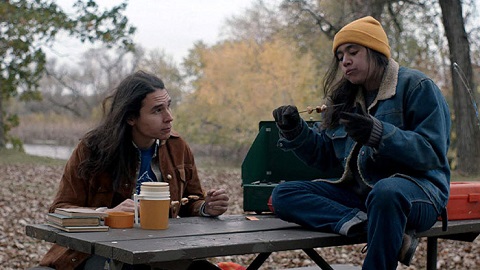
The reason why Margo Crane (Kenadi DelaCerna) has been forced to make her way along the river is a complex one, and can be traced to her home life. What she is doing is trying to trace her mother, Luanne (Lindsay Pulsipher), who left her when she was a small child to be brought up by her father Bernard (Tatanka Means). As they were Native American and this was the Michigan of 1977, they did not get much respect in the local community, not even for Margo's talent with a rifle with which she hit the bullseye every time, but not helping was that her father's half-brother had taken a sexual interest in the fifteen-year-old. When they were spotted having sex one night, it sparked a chain of events that would ultimately end in tragedy...
But after that tragedy, well, maybe some hope would arise in writer and director Haroula Rose's adaptation of Bonnie Jo Campbell's book which did pretty well at festival engagements, it being as indie a drama as it was possible to get, both in tone and presentation. Really it was a road movie, except there was a river running through it rather than an actual road, which Margo travels down in a boat or alternatively, by the shore, meeting a variety of people along the way who variously helped her out. What has instigated this journey is the death of her father early in the story, which we see in flashback as he was shot by her cousin, who thought he had shot his father, when in fact it was Margo who pulled the trigger. So you can see this was soap opera level complex already.
As the focus of this, DelaCerna was well-cast inasmuch as she fulfilled the physicality of the role and convinced as a tough survivor of unenviable circumstances, but for some reason Rose's script served her less well in the personality department. She was a character who things happened to more than she was a character who made things happen, and that was kind of frustrating, not quite a portrayal of a life drifting down the titular river if she steered herself occasionally, but with less agency than would be preferable for downtrodden heroines in this kind of context for a film made in this century. Despite a smattering of voiceover at the beginning and the end, this paid mere lip service to anything other than Margo's drive to survive, and the people she meets simply accept her story and assist in ways that don't involve any huge sacrifice on their part.
Her mother had her when she was a teenager, so it's somewhat frustrating to see Margo make the same mistakes with unprotected sex, and while this makes it as clear as it can that she is not being taken advantage of, not even by her uncle, well, of course she's being taken advantage of, these are older men and she is in her mid-teens. So when she gets knocked up after a hitchhiking turns, er, romantic, we are given no hint of how we are supposed to react - good for her for controlling her own sex life, or bad for her for being foolhardy when the prospects for her child, if she goes through with the birth, are dim? The piece toyed with a bunch of weighty issues but did not get to grips with any of them, leaving us with Margo encountering some neat character turns from some capable performers (John Ashton appeared late on as an elderly chap who gives her shelter, for instance), but never feeling as if she's progressing, seemingly doomed to live in the backwaters of the seventies forever. That was poetic in itself, and it was a meditative item overall, but it really needed to take its premise by the scruff of the neck. Music by Zac Rae.