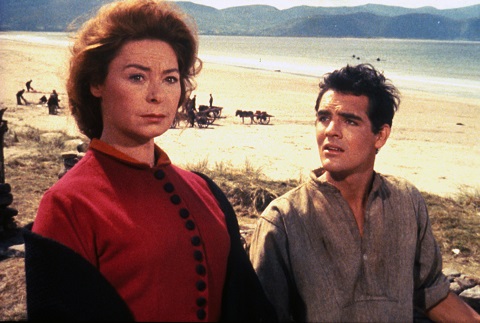
Pegeen Mike (Siobhan McKenna) runs a tavern on the coast of rural Ireland, and one night she is interrupted by one of her regulars, Shaun (Michael O'Brian) who is in quite a state, for he believes he has seen - or heard, anyway - a dying man in a ditch next to the road where he was walking. When more regulars arrive, they make great sport of him, sending him into a panic, and rushing out of the door leaving his jacket behind, but then it turns out he was not wrong, for there is someone out there in a state of unease. He walks in and they look wary: he is Christy Mahon (Gary Raymond), and he has good reason to be out of sorts, for he has just murdered his own father by beating him around the head. How better to win the admiration of all present?
The Playboy of the Western World is considered the masterpiece of Irish literary talent John Millington Synge, though it did not receive a warm welcome at the time of its debut, the play causing riots when it was performed for its supposed lack of morality and portrayal of the nation's womanhood as being of lax standards. Let's say it was misunderstood, for as the years went by, and sadly Synge fell victim to cancer in his thirties, its love of language became recognised and as actors liked to speak those lines with relish, it did not take that long to be a favourite among Irish and indeed British thespians - Raymond, for instance, was not Irish himself, but a Londoner putting on the accent, which may be one reason this film version doesn't quite win the respect it might have done.
Another reason was that it was difficult to see, as thanks to rights issues it merely had a limited release at the time, and only intermittently resurfaced; also, it did not have any big names attached to it - big names in the theatre, yes, but not in the movies. McKenna was regarded as one of the best performers of her generation as far as the stage went, but she never really gained a foothold in other media, similarly Elspeth March, who plays the Widow Quin here, as she did on hit stage performances, enjoyed a distinguished career treading the boards, but you would be hard pressed to think of a screen appearance that did her justice. The rest of the cast here were filled out with other stage performers, leaving the most famous names in it probably Niall McGinnis (the villain from Night of the Demon) and Liam Redmond, a prolific character actor.
Maybe the problem with this adaptation is that while writer and director Brian Desmond Hurst (who made Scrooge a decade before) obviously had love for the material, as did the whole cast, it was probably best suited to the theatre, where the dense language would be better appreciated. By opening out that tone with such extraneous business as the world outside the inn, that can become a distraction, and while even the less attuned to the dialect can understand what the gist of the plot was - Christy is lusted after by the local women for his act of rebellion against his tyrannical father (McGinnis), but their ardour cools when it turns out he did not finish the job and may be more of a loser than they anticipated - it was really the spoken word that was important here. The poetry of the dialogue and its roots in Ireland at least made this a valuable record of the play, but aside from some sweeping scenery it was oddly televisual and rarely convinced you that it was ideal for filming. So we're stuck with the historical interest tag, which is assuredly present, but maybe for the existing fans of Synge's writing. Music by Sean O'Riada.
[Network release this as part of their The British Film brand of Blu-rays (technically it was a British film, anyway), with an interview with the affable Raymond, the trailer, an image gallery and subtitles as extras.]