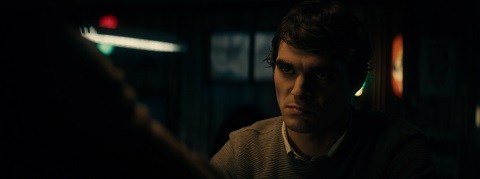
It is a snowy night and in this bar, the bartender Paul (Peter Outerbridge) has not seen many customers as he closes up for the evening, they have been put off by the bad weather. However, just as he is about to get going himself a figure all wrapped up bursts into the room and starts to advance on him: alarmed, he prepares to defend himself until the man whips off his balaclava and reveals himself as Steve (RJ Mitte). Paul knows him from years before, he is the son of one of his former regulars who passed away a while back, and Steve was not noticed at the funeral. For this reason he feels resentment towards the young man and does not want to listen to him, but Steve has some stories he wants to tell, stories about a bar some distance away and not so long before...
The Oak Room was based on a play, adapted by Peter Genoway for the screen, and you could definitely tell its origins given it largely inhabited two very similar-looking bars which could have been easily arranged on the stage, and presumably was just as easily arranged on the set of the movie. It took its inspiration from the fine art of the shaggy dog story, where a yarn will be teased and drawn out until the punchline is reached, if indeed there was a punchline at all. Therefore its whole technique was to present a selection of stories as you would hear in a barroom, told with the finesse of a veteran storyteller, not someone who would make a living from that talent, but someone who would entertain the patrons with a monologue that may be headed somewhere, but then again may not.
Certainly, there were many points here where you would be wondering if you were wasting your time listening to this near-constant stream of chatter, and director Cody Calahan, as well as the writer, appeared to be amusing mostly themselves as they dangled the audience on the line like the oft referred to fish. You were going to have one of two reactions to this, either be intrigued and consumed with curiosity about where it was all going when the finishing line was so oblique from the perspective of anywhere in the film until the last ten minutes or so, or you would be turned off utterly by a work that was so determined to make you wait for its pay-off that it became almost perverse in its lack of interest in doing anything but string the viewer along. And even then, when the big reveal came you found there might well have been a problem you had not anticipated.
That being that to allow the pieces to fall into place, you would have had to be paying rapt attention to every little nuance of that abundant talk so you would perceive exactly why the twist happened the way it did. For many, this would not be worth their bother, and that was perfectly fair, but if you liked a solid filmed play, something like The Iceman Cometh (also set in a bar), then you may be content to soak in the performances as they played out before you, the actors sparring with obvious enthusiasm for their roles and the effect the whole thing would have for those who were, effectively, hooked. Every time there appeared to be a digression, a cul-de-sac in the plotting, it would be best if you marked well what it was telling you, otherwise this was a film that was going to come across as completely pointless. One for a specialist market, then, but even the most unimpressed audience member would have to admit that while the dialogue was a shade self-conscious in places, with the swearing overdone to toughen the characters up, there was little amiss with the performances, and it did have a singular atmosphere. Music by Steph Copeland.
[The Oak Room will available on Digital Download from 26th April 2021.]