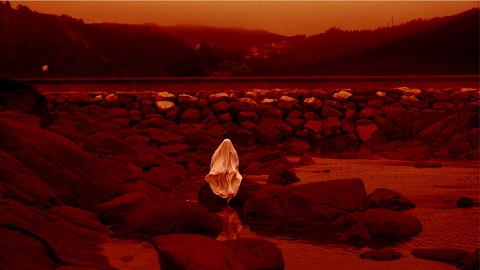
Ah, Rubio, there was a man, the villagers all agree, the only one who took matters into his own hands and sought to thwart the sea monster which had been ruining their fishing catches. He was a hero who endeavoured to rescue the imperiled from the deep, and would regularly save people from drowning, but now it seems those days are over when he failed to return from one excursion, and the villagers are left utterly bereft. What can they possibly do now all hope appears to have gone? One thing they can do is stand about the landscape, on shore and in the nearby forest, and muse over their fate, for if they cannot work out a way out of this predicament with Rubio gone, then there is no hope for any of them, and they might as well give in to the approaching devastation...
Red Moon Tide, or Lua Vermella as it was originally called, was one of those art movies that was going to appeal to a very small group of people, and either baffle the rest or leave them completely stupefied with boredom. It would be all too easy to let the watery imagery wash over the viewer, and indeed director Lois Patino looked to be actively encouraging that reaction, but that did not necessarily mean you could not be engaged with it, as if you got on its wavelength you could find yourself in a state of palpable disquiet once its implications began to sink in. At heart it was a tale of climate change and the ramifications that would bring to the world, as witnessed in a small part of Spain, Galicia to be precise, a land well known for striking countryside that was well to the fore in this.
The naysayers would see the cast, a collection of amateurs, standing about in a daze (apparently they were hypnotised for their roles, in the way Werner Herzog set about Heart of Glass back in the seventies) amidst some variously picturesque locations and wonder what on Earth the point of watching any further would be; certainly when three "witches" show up and start draping white sheets over them, the piece skirted close to self-parody. But that soundtrack told a different story, a combination of sinister, beastlike moans and groans, portentous narration that did not clear up very much, menacing musical themes and the occasional sound effect like a crash to startle you out of a possible stupor, or footsteps making their journey across the sodden ground. One hesitated to term it immersive, that being a buzzword that many entertainments and artworks alike strive to achieve in the twenty-first century, but that was patently aimed for.
There was a plot of a kind, though you could be forgiven for missing it, so perhaps a better experience with Red Moon Tide was to take it all in and see where the moods it elicited led you. Although there were undoubtedly attractive sights to be seen in this region of the world, the film did not present a travelogue, preferring to mix and match its views between striking nature shots and some grimmer footage ranging from closeups in difficult to make out caves of gloom or house interiors that had been somehow affected by this looming catastrophe we kept hearing about. The apocalyptic quality of the tone was also very much of its time, what with climate change a daily news story by this point, though here it was posited as a mythical event, not because it was not true, but because it was featuring the return of some leviathan to the stage should the fallen hero not be able to get back up again. If that was a little silly, then the director did not style his picture that way, leaving it with the utmost seriousness to linger as much in the mind as it did on the screen. No, not one for mass appeal, but it did tap into something.