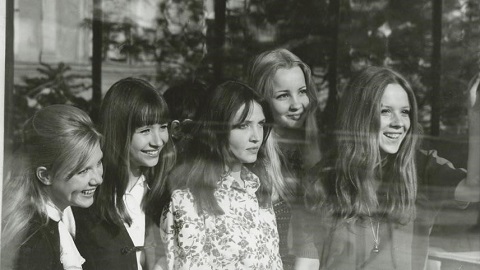
Juli (Jaroslava Schallerova) is a young woman living in Hungary who is engaged to be married to Savanyu (Mark Zala), who works at the local factory. But it is the Summer of Love, which has reached their country a little later than the rest of the world yet has no less impact as the youth consider their options and their futures and the way that they might not exactly be everything they dreamed of. As all this is happening, there is an open-air concert being planned with some of the top bands of the time to watch, and Juli is most taken with a cello player who has been practicing near a cafe across from the factory. This leads her to a choice: does she get married and give up her freedom, or does she stay single?
Don't Cry, Pretty Girls! was the contribution by prolific Hungarian director Marta Meszaros to the burgeoning hippy movement of the mid-to-late nineteen-sixties, except that she arrived to the party a little late, by which point the chairs were being packed away and the lights turned on to reveal a definite dissatisfaction with the looming decade of the seventies. That this was occurring just as the Western world was reckoning with their Summer of Love seeming a very long time ago, and growing longer ago by the minute, left her film as a time capsule of a moment that was already passing when she released her story, and the up to the second bands she included only served to date the premise and results even further, to the stage that it may come across as quaint.
Certainly the manner in which Meszaros liked to play her camera over the faces of the young folks who were listening to the music suggested she was lost in a reverie of sorts, where the increasing cynicism of the West was nothing compared to a land where the hardline Communists were going to crack down on any of that dopey peace and love stuff, leaving twenty more years behind the Iron Curtain for the citizens to endure before they could start to regroup and wonder where they could head next. The idyll of simply taking in a band, especially one playing such sixties-specific music, in the open air, where the weather was clement and you could soak up the atmosphere of being in a crowd of likeminded funseekers, was all over this movie, yet so was a sadness that it was all so ephemeral and real life had to be returned to sooner rather than later.
In the lead was the mysterious Schallerova who that same year had starred in a far more celebrated film, Valerie and Her Week of Wonders, where she had made an impression as the titular nymph, though her character was intended to be more grounded here than in that famous fantasy. However, her marked enigma, possibly because she does not say a tremendous amount other than "Hi!" in this, was carried over, and though she continued to act in other films, she never went onto international stardom in a style of other European beauties post-Brigitte Bardot. That she was so well suited to the hippy milieu, as we can witness from how she was presented across scene after scene, added a layer of melancholy to watching her, as if she too was well aware of the lack of hope in the youth movement she was part of, but only tangentially as her fellow countrymen and women were, thanks to being out of the action in the neglected Eastern bloc state of Hungary. The sense of missing out was all over this.