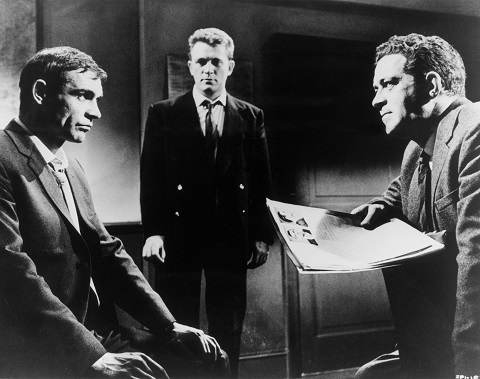
This private club is a good place for men to pick up looser women than they may have found in more respectable establishments, but tonight it's also a good place to get your head smashed in when the heavy mob of a protection racket break through the door and start disrupting it with force. The next day, the owner surveys the wreckage, but once the police get wind of the crime and show up to try and take some names, that owner clams up and merely says the patrons got out of hand. This is the problem facing Detective Inspector Sayers (John Gregson): he knows there is a protection money changing hands, the victims know it too, but won't admit it.
Crime movies were the easiest genre to churn out for a long time in Britain, you could argue they still are as they will always find an audience, but with such a plethora to contend with, it would also be easy to be swamped in the sea of mediocrity that many fell into. The year The Frightened City was released, they were part of supporting programmes on double bills as well as sometimes the lead movie, but in a climate that saw criminal gangs and corrupt authorities rubbing shoulders until crusaders like Sir Robert Mark put a stop to it, or tried to anyway, is it any wonder the public had an unchecked fascination with the seedier side of life as it was lived in Britain?
The fact that The Frightened City (from John Lemont, the director of the same year's camp classic Konga) went on to be a huge domestic hit tells you all you needed to know, and that lead Gregson would go to star in the popular cop television show Gideon's Way, which was obviously patterned after this and entertainment like it, indicated that thirst for poring over the lawbreakers in all their forms was a preoccupation the Brits couldn't get enough of. Considering in the next century the big shows were also crime thrillers, commanding millions of viewers on terrestrial TV at a time we were told such broadcasts were losing out to distractions like gaming and streaming bingewatches, means there were still audiences for them.
And indeed, the fascination reached back into the past, as vintage crime movies and television were able to generate surprising amounts of attention, though it would help, as it did here, if there was a big star to draw in that viewership. No, not Gregson - he was a major celebrity in his day, but not so much decades later - it was Sean Connery who was the object of fascination, the greatest star Scotland ever produced and commanding a following across generations of filmgoers. In this he was Paddy, a cat burglar at a loose end now his partner (Kenneth Griffith) has been injured on a job and is disabled permanently. When outwardly respectable but inwardly rotten Herbert Lom and Alfred Marks invite Paddy to join their new scheme to really organise a London-wide protection scheme, as their muscle, he reluctantly agrees.
He's an intriguing character made distinctive by Connery's natural charisma, verging on the brutish but with a certain sympathetic quality too that leaves you unsure of how to take him, but well aware he is preferable to the smooth yet nasty Lom and Marks. Lom could play this role in his sleep, of course, he had been hired as Continental villains ever since establishing himself, but Marks was unusual in that he was best known for comedy at the time, and proving himself as a vicious baddie here paved the way for a more diverse career. It was a good cast all round, not everyone recognisable but they all operated well together, be they Yvonne Romain as one of her cliched foreign exotics (but injecting some vulnerability that has us worrying for the character) or in smaller roles, George Pastell, the Cypriot performer who made countless appearances this era, and Marianne Stone, the most prolific character actress in the British film industry. All in all, it accumulated a sense of danger in its brisk efficiency that impressed. Music by Norrie Paramour (Hank Marvin twanged on the theme tune).
[THE FRIGHTENED CITY is available to buy on Blu-ray, DVD and Digital from 12th April 2021. The sole extra on the disc is a featurette from commentator Matthew Sweet.]