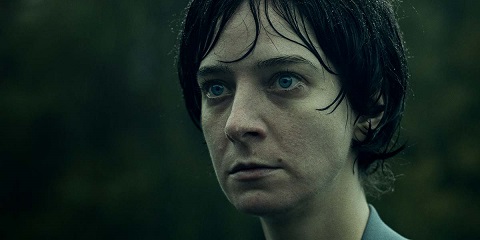
Miriam (Madeleine Sims-Fewer) is being driven out to her sister Greta (Anna Maguire) at her lakeside retreat. Miriam's husband Caleb (Obi Abili) is doing the driving, and they are not really speaking on the journey, an example of how their marriage has hit a rough patch, but is Greta's arrangement any better? Her husband is Dylan (Jesse LaVercombe) who seems like a nice enough guy, and maybe Miriam is wondering in her subconscious how she could win him over and claim him as substitute for Caleb, but she would be wise to keep those thoughts to herself... who knows how people could react?
The practice of sawing up bodies to dispose of them is not a new one in the movies, you could go back to Amicus's Asylum to see an early example, and Henry: Portrait of a Serial Killer was another memorable instance of the cinematic practice, but it was perhaps Takashi Miike's Audition that indicated the potency of the concept of a woman cutting up a man, a reversal of the usual tropes that placed the power in the hands of the female. Since then, Dusty Mancinelli and star Sims-Fewer's Violation were invested in it enough not to make it a sick joke or a gross-out setpiece but try for something more realistic instead.
That said, the stories in real life of women (or indeed men) dismembering their violators are few and far between, not that it could not happen but to watch it here did remind you of the essential fantastical nature of the horror genre. The rape that is central to the plot awakens a savagery in Miriam that both operates as an impulse she doesn't know what to do with, yet also paradoxically centres her mind to take revenge on this man as a representative of all men, since she would believe all men are capable of this crime. However, that would not mean all women are capable of this kind of vengeance-fuelled violence to get even.
That the rape-revenge genre is often reclaimed, or attempted as such, as an empowering one for women since they take the law into their own hands and exact a grim justice as catharsis is a notion that emerged in the nineteen-seventies, when screen violence became more explicit, but the fact remained a lot of male viewers were watching for its combination of sex crimes and bloody reactions to those crimes. Yes, there was a kick to be gained from seeing a powerful woman taking on her foes, but to do so she had to be in the worst possible position first, short of actually being murdered, and therefore in no state to do anything much, and that brings in the dreaded word "problematic" as we wonder how we can justify this as entertainment; certainly here entertainment did not appear to be on the overall agenda. Of course, some audiences don't give a shit about justification.
This team was a lot more thoughtful, to the extent that there was a lot of space for rumination in Violation, indeed the film positively encouraged you to look on at the dynamics of rape and revenge and draw your conclusions. Yet the latter part of that was strictly shocker flick material, which meant you would be contemplating these conventions in a movie context rather than real life; you could argue even a well-regarded depiction of rape's effects like the Oscar-winning The Accused was not much better, given it treated the assault as a highlight of the movie in a thriller style, and Mancinelli and Sims-Fewer were pushing the viewer's noses in the violence as seen in the movies rather than a documentary about it in actuality. Did this do anyone a disservice, is what we should maybe be asking? Not fictional characters, who can behave how they like, but it was prudent not to respond as if they had tapped into a deeper truth. Though if it shorted the processes that go through the mind of an assaulter because they considered their potential actions, fair enough. Music by Andrea Boccadoro.
[Violation is available to stream digitally on Shudder now.]