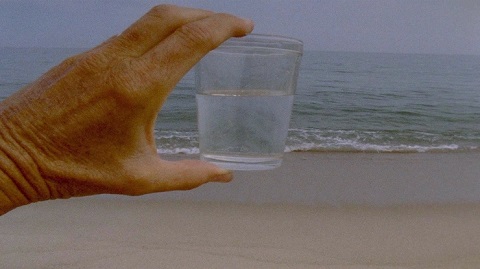
In 1998, feminist filmmaker Barbara Hammer felt she was nearing the end of her life, or at least was nearer to it than ever, and at an artist's retreat in Cape Cod, Massachusetts, therefore set about recording her experiences to capture the very minutiae of what she would lose once she had passed away. Twenty years later, months before she died, she returned to this unused footage, which had images only, not sound, and her friend and fellow filmmaker Lynne Sachs assembled it for her, accompanied by an interview.
It is said death is the big inevitable, the one thing that binds us all together, and as such it has created a fascination in filmmakers be it as entertainment, punishment for evildoers, tragedy striking innocents down, and so on. But with this short film, barely a quarter hour long, the reflection that comes with a death happening at the end of a fairly substantial life was the subject matter, since it would generate many thoughts that would be accompanied by a cascade of visual memories.
Now, in the twenty-first century, it seems everyone records their oh-so-precious memories electronically, meaning presumably once they reach their final bow they will not so much rely on their minds to recollect how they spent their lives, but with what they can reproduce on a screen. So it was with Hammer, encouraged by Sachs to make observations on the 16mm reels she recorded back in 1998 as they played across the screen that you, watching the film, would be able to experience second hand.
So what was the difference between getting to the dying of the light and scrolling through your Instagram and what Sachs and Hammer did here? Maybe it was the artist's eye that this was shot with, though in truth what was valuable about the footage was anyone could have taken it in the same circumstances, it was just that it was universal to the opportunities it presented and specific to the place and time that Hammer was living for a month at what was in effect a beach hut away from everyone in the world.
We witnessed anything from the animals she filmed, to the skies that looked huge and impressive, to herself taking a shower outside (nobody around, so she could do that), all of it feeding into that short period spent at that location which anyone could have done in a similar way, but did not, and each tactile sense of what she was inhabiting grew clearer in every one of those titular frames. Really it was a sliver of a piece, an item of memory that meant the most to Hammer as she was there for it, yet could evoke experiences the viewer has had at the same time, never needing to resort to their own library of clips and visuals when there was the personal version they were carrying around in their heads. As she philosophises on the soundtrack, you may think she was onto something indelible here...